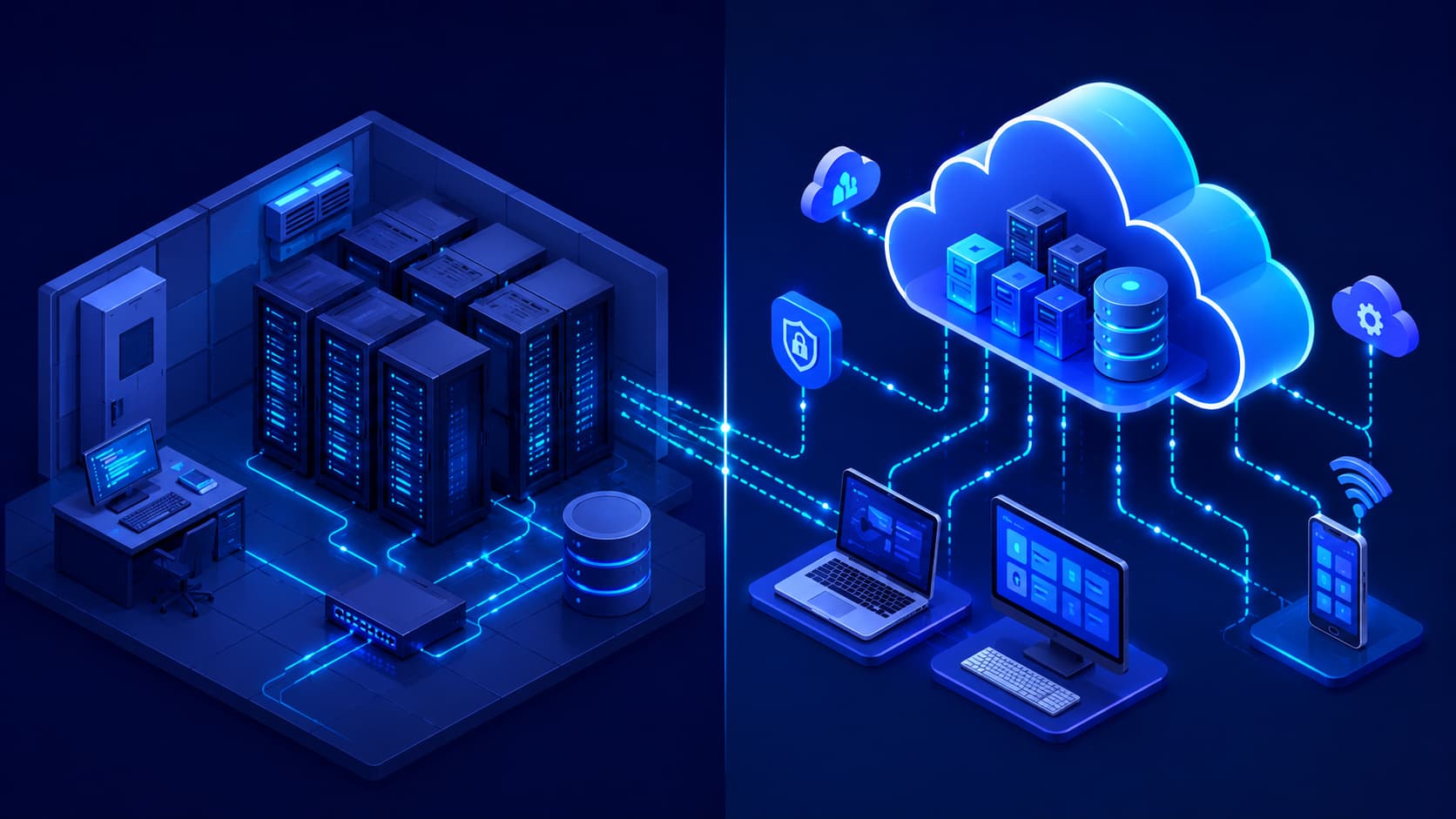
A little over a decade ago, launching a new application usually meant purchasing physical servers, preparing a dedicated server room, installing operating systems, and waiting days—or even weeks—before everything was ready.
Today, the process is dramatically different.
A developer can create a virtual server in the cloud within minutes, deploy an application, and make it available to users around the world without ever touching a piece of physical hardware.
This transformation is one of the biggest reasons cloud computing has become so widely adopted.
However, that doesn't mean traditional computing has disappeared.
Many organizations still operate their own servers because they require complete control over their infrastructure, must comply with strict regulations, or rely on legacy systems that weren't originally designed for the cloud.
Instead of asking which approach is universally better, it's more useful to understand how they differ—and where each one delivers the greatest value.
What Is Traditional Computing?
Traditional computing, often called on-premises computing, is the approach organizations relied on long before cloud services became mainstream.
In this model, the organization owns or leases its own IT infrastructure. Servers, networking equipment, storage devices, and other hardware are installed inside company offices or dedicated data centers.
Unlike cloud computing, where infrastructure is managed by a provider, everything remains under the organization's direct responsibility.
This includes:
- Purchasing hardware.
- Installing operating systems.
- Applying software updates.
- Replacing failed equipment.
- Monitoring security.
- Performing ongoing maintenance.
For many years, this was the standard way organizations built and managed their IT infrastructure.
Even today, industries with demanding regulatory or operational requirements continue to rely on on-premises environments for specific workloads.
Why Some Organizations Still Use On-Premises Infrastructure
Despite the rapid growth of cloud computing, traditional infrastructure continues to serve an important purpose.
Organizations may choose to keep systems on-premises because they need:
- Complete control over hardware.
- Custom infrastructure configurations.
- Support for legacy applications.
- Compliance with industry regulations.
For these organizations, maintaining direct ownership of infrastructure may be more valuable than the flexibility offered by cloud services.
Editorial Insight
Traditional computing isn't outdated technology. In many industries, it's still the right solution for workloads that require maximum control, predictable performance, or strict compliance with security regulations.
What Makes Cloud Computing Different?
Cloud computing takes a fundamentally different approach.
Instead of purchasing and maintaining physical infrastructure, organizations rent computing resources from cloud providers and access them over the internet.
Need additional storage?
It can often be added with just a few clicks.
Need more processing power during a busy period?
Resources can usually be scaled almost instantly.
Rather than spending time managing hardware, organizations focus on using the services those resources provide.
This significantly reduces the effort required to install equipment, replace components, and maintain physical infrastructure.
Service Instead of Ownership
One of the biggest philosophical differences between traditional computing and cloud computing is ownership.
With traditional infrastructure, organizations purchase and maintain the equipment themselves.
With cloud computing, organizations consume technology as a service.
Instead of asking:
"Which server should we buy?"
Businesses increasingly ask:
"Which cloud service best supports our application?"
This shift allows organizations to respond much more quickly as business requirements evolve.
Greater Business Agility
Because cloud providers manage much of the underlying infrastructure, businesses can:
- Launch new services faster.
- Expand resources quickly.
- Reduce infrastructure management.
- Focus more on product development.
This flexibility has become one of cloud computing's greatest competitive advantages.
Best Practice
Cloud computing doesn't eliminate the need for IT expertise. Instead, it shifts the focus from maintaining hardware to designing, managing, and optimizing cloud-based services that support business goals.
Comparing the Two Approaches
At first glance, both traditional computing and cloud computing accomplish the same objective.
They provide computing resources for applications, data, and users.
The key difference lies in how those resources are delivered and managed.
Traditional computing emphasizes:
- Ownership.
- Direct infrastructure control.
- Internal management.
Cloud computing emphasizes:
- Flexibility.
- Scalability.
- Service-based resource delivery.
Neither approach is inherently better than the other.
The right choice depends on several factors, including:
- Budget.
- Security requirements.
- Technical expertise.
- Expected business growth.
- Long-term IT strategy.
Choosing between them is ultimately a business decision as much as a technical one.
Cost: Upfront Investment vs. Pay-as-You-Go
One of the most significant differences between traditional computing and cloud computing is how organizations pay for their infrastructure.
Traditional Computing
With traditional infrastructure, organizations typically make a substantial upfront investment before they can begin operating.
This often includes purchasing:
- Physical servers.
- Storage systems.
- Networking equipment.
- Backup solutions.
- Software licenses.
Even after deployment, ongoing expenses continue through:
- Electricity.
- Cooling systems.
- Hardware replacement.
- Maintenance.
- IT personnel.
These costs remain regardless of how heavily the infrastructure is being used.
Cloud Computing
Cloud computing follows a different financial model.
Instead of purchasing hardware, businesses generally pay only for the computing resources they actually consume.
If demand increases, resources can scale upward.
If demand decreases, organizations can reduce their usage—and often lower their costs accordingly.
This pay-as-you-go approach makes cloud computing particularly attractive for startups and growing businesses that want to avoid large capital investments while maintaining the flexibility to expand quickly.
Scalability
Imagine an online store preparing for a major shopping event such as Black Friday.
On a normal day, a few servers may be sufficient to handle customer traffic.
During a holiday promotion, however, visitor numbers can increase dramatically within just a few hours.
Traditional Computing
In a traditional on-premises environment, the company would need to purchase enough hardware to support those peak traffic periods.
The challenge is that much of this additional capacity may remain unused for most of the year.
This can result in:
- Higher infrastructure costs.
- Underutilized hardware.
- More complex capacity planning.
Organizations must prepare for their busiest days even if those conditions occur only occasionally.
Cloud Computing
Cloud computing approaches scalability very differently.
Instead of permanently purchasing additional servers, businesses can increase computing resources automatically when demand rises and reduce them once traffic returns to normal.
This elastic scaling allows organizations to:
- Respond quickly to changing workloads.
- Avoid purchasing unnecessary hardware.
- Pay only for additional resources when they're actually needed.
For businesses with seasonal demand or unpredictable growth, this flexibility is one of cloud computing's greatest advantages.
Why Scalability Matters
Business requirements rarely remain constant.
A startup may serve hundreds of users today and thousands next month.
A media website may experience sudden spikes in traffic after publishing popular content.
Without scalable infrastructure, organizations risk either:
- Purchasing far more hardware than they normally need, or
- Running out of computing resources during periods of high demand.
Cloud computing helps reduce both of these risks by allowing infrastructure to grow alongside the business.
Editorial Insight
Scalability isn't simply about handling more users. It's about giving organizations the ability to adjust computing resources efficiently as demand changes, helping balance both performance and operational costs.
Maintenance and Updates
Running traditional infrastructure involves much more than purchasing servers.
Organizations are responsible for everything that happens behind the scenes to keep systems running reliably.
Responsibilities in Traditional Computing
Over time:
- Hardware wears out.
- Operating systems require updates.
- Security patches must be installed.
- Storage devices eventually fail.
- Backup systems need regular testing.
Managing these responsibilities requires:
- Skilled IT professionals.
- Careful planning.
- Ongoing maintenance.
- Dedicated operational resources.
Infrastructure management becomes a continuous responsibility rather than a one-time setup.
Maintenance in Cloud Computing
Cloud computing reduces much of this operational burden.
According to the source material, cloud providers manage much of the underlying hardware infrastructure, while customers continue managing their own applications and data.
This division of responsibility allows organizations to spend less time maintaining infrastructure and more time:
- Developing products.
- Improving customer experiences.
- Supporting business growth.
It's important to remember that cloud computing doesn't eliminate IT responsibilities—it changes where those responsibilities are focused.
Best Practice
Even when using cloud computing, organizations should maintain clear operational processes for application updates, backups, monitoring, and security. While cloud providers manage much of the infrastructure, customers remain responsible for protecting the applications and data they place in the cloud.
Security
Security is often one of the first topics discussed when comparing cloud computing with traditional infrastructure.
Some people assume that keeping everything on their own servers is automatically safer.
In reality, security depends far more on how systems are designed, configured, and managed than on where they're physically located.
Security in Traditional Computing
Organizations operating on-premises infrastructure have complete control over their systems.
However, they are also responsible for:
- Physical security.
- Network protection.
- Software updates.
- Access controls.
- Incident response.
Maintaining a secure environment requires continuous investment in both technology and skilled personnel.
Security in Cloud Computing
Leading cloud providers invest billions of dollars in:
- Cybersecurity.
- Physical security.
- Monitoring systems.
- Compliance certifications.
These providers operate at a scale that allows them to build highly sophisticated security capabilities.
However, cloud customers still have important responsibilities.
They must properly:
- Protect user accounts.
- Configure permissions.
- Secure their applications.
- Manage access to sensitive data.
Shared Responsibility
Whether infrastructure is located on-premises or in the cloud, security is never guaranteed simply by choosing one technology over another.
Effective security depends on good planning, strong operational practices, and continuous monitoring.
This is why many cloud providers describe security as a shared responsibility between the provider and the customer.
Editorial Insight
The debate isn't "cloud security versus traditional security." The more important question is whether an organization has implemented the right security practices for the environment it has chosen. Technology alone cannot replace sound security management.
Which One Is Better?
The answer depends entirely on your organization's goals and operational requirements.
Traditional computing may remain the better option for organizations that require:
- Complete hardware control.
- Strict regulatory compliance.
- Support for legacy applications that are difficult to migrate.
Cloud computing is often the stronger choice when priorities include:
- Flexibility.
- Scalability.
- Faster deployment.
- Lower upfront infrastructure costs.
Many organizations don't choose one approach exclusively.
Instead, they combine both using a hybrid strategy, keeping certain systems on-premises while moving others to the cloud.
Rather than replacing traditional computing entirely, cloud computing has expanded the range of infrastructure options available to modern businesses.
Side-by-Side Comparison
Cloud computing and traditional computing both provide the computing resources that modern applications require.
The difference lies in how those resources are delivered, managed, and paid for.
The following comparison summarizes the key differences described in the source material:
| Traditional Computing | Cloud Computing |
|---|---|
| Requires purchasing physical hardware | Resources are delivered over the internet |
| Higher upfront investment | Pay only for the resources you use |
| Scaling often requires purchasing new hardware | Resources can usually scale within minutes |
| Organization manages all infrastructure | Cloud provider manages the underlying infrastructure |
| Best for organizations needing complete hardware control | Best for organizations seeking flexibility and rapid growth |
Neither approach is universally better.
The right decision depends on the organization's:
- Business objectives.
- Security requirements.
- Budget.
- Technical expertise.
- Long-term infrastructure strategy.
Choosing Based on Business Needs
A small startup launching its first application has very different infrastructure requirements than a government agency managing confidential information.
Likewise, a rapidly growing online business may prioritize scalability, while a manufacturing company running specialized legacy systems may prioritize long-term stability.
Rather than following technology trends, successful organizations evaluate which approach best supports their operational goals.
Editorial Insight
Modern IT is no longer about choosing between cloud computing and traditional infrastructure. Increasingly, organizations select the technologies that best fit each workload, combining different approaches to create flexible, secure, and cost-effective environments.
Frequently Asked Questions
Is Cloud Computing Replacing Traditional Computing?
Not entirely.
While many organizations have moved significant workloads to the cloud, traditional infrastructure continues to play an important role—particularly in industries with specialized security, compliance, or operational requirements.
Rather than disappearing, traditional computing has become one option among several infrastructure strategies available to modern businesses.
Is Cloud Computing Always Cheaper?
Not necessarily.
Cloud computing often reduces upfront investment and provides greater flexibility.
However, long-term costs depend on several factors, including:
- Resource usage.
- Infrastructure management.
- The cloud services being used.
Organizations should evaluate both short-term and long-term expenses before making infrastructure decisions.
Why Do Some Companies Still Use On-Premises Servers?
Many organizations continue using on-premises infrastructure because they require:
- Direct control over hardware.
- Compliance with strict regulations.
- Support for systems that are difficult to migrate to the cloud.
For these organizations, maintaining local infrastructure remains the most practical solution.
Can Businesses Use Both Traditional and Cloud Computing?
Yes.
Many organizations adopt a hybrid approach, combining on-premises infrastructure with cloud services so they can benefit from the strengths of both environments.
For example, a company might:
- Keep sensitive internal systems on-premises.
- Host customer-facing applications in the cloud.
- Use cloud storage for backups and disaster recovery.
This approach provides greater flexibility while maintaining control where it's needed most.
Which Option Is Better for Small Businesses?
For many small businesses, cloud computing provides an affordable and scalable way to access modern IT infrastructure without making large investments in physical hardware.
Its pay-as-you-go model and rapid deployment capabilities make it particularly attractive for organizations that want to grow without significant upfront capital expenditure.
Conclusion
Cloud computing and traditional computing both provide the technological foundation that supports today's digital services, but they do so in different ways.
Traditional infrastructure emphasizes direct ownership and complete control over hardware.
Cloud computing focuses on flexibility, scalability, and faster access to computing resources.
Rather than viewing one approach as the clear winner, it's more useful to understand where each performs best.
Many modern organizations now combine both models to create infrastructure that is:
- Secure.
- Adaptable.
- Cost-effective.
- Ready to support future growth.
As technology continues to evolve, infrastructure decisions are becoming less about choosing one model over another and more about selecting the right solution for each business need.
Final Takeaway
Traditional computing and cloud computing are not competing technologies—they are complementary approaches to delivering IT services.
Traditional infrastructure remains valuable for organizations that require maximum control, while cloud computing provides the agility and scalability needed in today's fast-moving digital landscape.
By understanding the strengths and trade-offs of each approach, you'll be better prepared to evaluate infrastructure decisions, whether you're managing personal projects, supporting business applications, or building a career in cloud computing and DevOps.