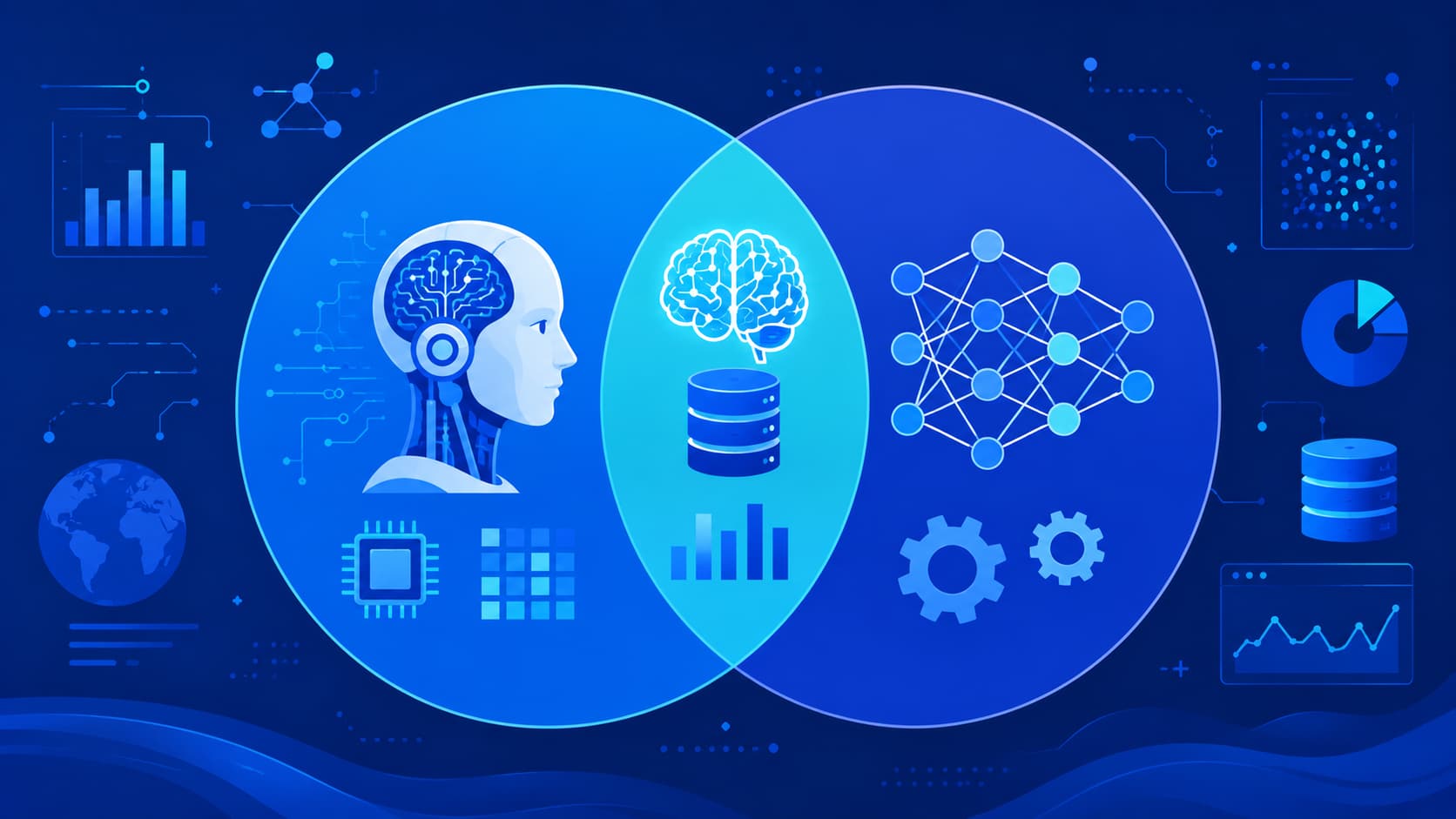
If you've been learning about artificial intelligence for any length of time, you've probably encountered a confusing situation.
Some articles discuss artificial intelligence (AI), while others focus on machine learning (ML). In many cases, the two terms appear side by side, leading beginners to assume they describe exactly the same technology. Other times, authors treat them as completely different subjects without clearly explaining how they relate to one another.
The reality is much simpler than it first appears.
Artificial intelligence and machine learning are closely connected, but they are not interchangeable. Instead, they represent different levels within the same technological ecosystem.
One of the easiest ways to understand their relationship is through this simple idea:
- Artificial Intelligence is the destination.
- Machine Learning is one of the roads that leads there.
Once you understand this relationship, many AI concepts become significantly easier to follow. Instead of viewing AI and machine learning as competing technologies, you'll recognize that they work together to create many of the intelligent systems we rely on every day.
Whether you're reading technology news, taking an online AI course, or evaluating the latest AI-powered products, understanding this distinction will help you interpret information more accurately and avoid one of the most common misconceptions in artificial intelligence.
What Is Artificial Intelligence?
Artificial intelligence is the broader field of computer science dedicated to creating systems capable of performing tasks that typically require human intelligence. These tasks include understanding natural language, recognizing images, solving problems, making decisions, translating text, generating content, and much more.
Rather than referring to a single technology, AI serves as an umbrella term that encompasses numerous specialized disciplines working together to create intelligent behavior.
Some of these disciplines include:
- Machine Learning
- Deep Learning
- Computer Vision
- Natural Language Processing
- Robotics
- Reasoning Systems
Each discipline contributes different capabilities, but they all share the same objective: enabling computers to solve increasingly complex problems in ways that resemble human intelligence.
AI Is the Bigger Picture
Imagine building a modern city.
The city itself represents artificial intelligence.
Inside that city are transportation systems, communication networks, power grids, hospitals, schools, and countless other components working together to support everyday life.
No individual component is the city itself.
Instead, every component contributes to making the entire system function effectively. Artificial intelligence operates in much the same way. Machine learning is one important part of AI, but it isn't the entire field.
What Makes AI Different?
The primary goal of artificial intelligence extends beyond simple automation.
Traditional software follows predefined instructions created by programmers.
Artificial intelligence, however, aims to develop systems capable of behaviors traditionally associated with human intelligence, including:
- Learning from experience.
- Recognizing patterns.
- Understanding language.
- Making informed decisions.
- Solving unfamiliar problems.
Different AI systems achieve these goals using different technologies, which is why artificial intelligence is considered a broad scientific discipline rather than a single invention.
Practical Example
Consider a smartphone voice assistant.
When you ask it to set an alarm, answer a question, translate a sentence, or find the nearest restaurant, you're interacting with an AI-powered system.
Behind the scenes, multiple AI technologies cooperate to understand your speech, process your request, search for relevant information, and generate an appropriate response.
The user simply experiences "AI," even though several specialized technologies are working together simultaneously.
Editorial Insight
Many people associate artificial intelligence exclusively with AI chatbots or image generators because these technologies receive significant media attention.
In reality, AI has been part of everyday life for years.
Recommendation systems on streaming platforms, fraud detection in banking, navigation software, email spam filters, medical imaging analysis, and language translation services all demonstrate artificial intelligence solving different categories of problems.
What Is Machine Learning?
Machine learning is one of the most important technologies within artificial intelligence.
Instead of requiring developers to manually program every possible rule, machine learning allows computers to learn directly from data. By analyzing examples, identifying patterns, and continuously improving predictions, machine learning enables AI systems to become more accurate over time without explicit programming for every scenario.
This learning-based approach has become one of the biggest reasons artificial intelligence has advanced so rapidly during the past decade.
Learning Through Examples
Imagine teaching someone to recognize apples.
One approach would be to create an enormous instruction manual describing every possible size, color, shape, texture, and variation.
A far simpler method would be showing hundreds—or even thousands—of different apples.
Eventually, most people naturally recognize new apples they've never seen before because they've learned the underlying patterns instead of memorizing every individual example.
Machine learning follows this exact principle. It learns from experience by analyzing data rather than relying entirely on manually programmed rules.
Why Machine Learning Is So Effective
Every day, modern technology generates enormous amounts of data.
Instead of expecting programmers to anticipate every possible situation, machine learning enables computers to discover meaningful relationships within that information automatically.
This capability allows AI systems to:
- Improve recommendation engines.
- Detect financial fraud.
- Recognize speech.
- Classify images.
- Predict customer behavior.
- Support countless other intelligent applications.
Best Practice
When learning about machine learning, avoid thinking of it as a replacement for artificial intelligence.
Instead, view it as one of the most powerful methods that enables AI systems to become smarter through experience.
Keeping this perspective will make advanced AI topics much easier to understand later.
The Relationship Between AI and Machine Learning
One of the most common misconceptions is believing that artificial intelligence and machine learning are separate technologies competing with one another.
They are not.
Machine learning exists within artificial intelligence. Every machine learning system belongs to the broader field of AI, but not every AI system relies on machine learning. Understanding this distinction makes many AI-related discussions much easier to follow and helps explain why these terms are so frequently mentioned together.
Rather than thinking of AI and machine learning as alternatives, it's more accurate to think of them as different layers within the same technological framework.
Think of Nested Circles
A helpful way to visualize this relationship is through three nested circles.
- The largest circle represents Artificial Intelligence.
- Inside AI is Machine Learning.
- Inside Machine Learning is Deep Learning.
Each layer becomes increasingly specialized.
Deep learning is a specialized branch of machine learning, while machine learning itself is a specialized branch of artificial intelligence. This hierarchy explains why discussions about modern AI often include all three terms together.
Why They're Often Confused
The confusion largely exists because many of today's most successful AI applications rely heavily on machine learning.
For example, when someone says:
"AI recommended this movie."
The recommendation wasn't produced by artificial intelligence as a single technology.
Instead, the AI application used a machine learning model to analyze viewing history, recognize behavioral patterns, and predict which movie or television series the user would most likely enjoy watching next.
Machine learning provides the ability to learn from data.
Artificial intelligence provides the complete system that delivers the final user experience.
Practical Example
Consider an online shopping platform.
When you browse products, the website begins recommending items that match your interests.
The recommendation system itself is part of an AI-powered application.
The process of analyzing your browsing history, comparing it with millions of other customers, and predicting products you may want to purchase is handled by machine learning.
From the customer's perspective, the entire experience simply feels like "AI."
Best Practice
Whenever you encounter a new AI application, ask yourself two questions:
- What is the overall AI system trying to accomplish?
- Which technology enables it to learn from data?
Developing this habit makes it much easier to distinguish between artificial intelligence and machine learning in real-world applications.
Why Do People Confuse AI and Machine Learning?
One of the biggest reasons people confuse artificial intelligence and machine learning is that both technologies have advanced rapidly over the past decade.
As machine learning became the driving force behind many successful AI applications, the two terms started appearing together so frequently in news articles, online courses, product marketing, and research papers that they gradually became associated with one another.
Although closely connected, however, they serve different purposes.
Artificial intelligence represents the broader objective of creating intelligent systems.
Machine learning is one of the technologies that helps those systems improve through experience by learning from data instead of relying solely on manually programmed rules.
Modern AI Depends Heavily on Machine Learning
Many of today's most popular digital services rely on machine learning behind the scenes.
For example:
- Netflix recommends movies and TV shows.
- Spotify suggests personalized playlists.
- Online stores recommend products based on browsing behavior.
- Social media platforms personalize content feeds.
From a user's perspective, these services simply appear to be "AI."
Technically, however, the personalized recommendations are generated by machine learning models analyzing enormous amounts of behavioral data.
This distinction may seem subtle, but it's essential for understanding how modern intelligent systems actually work.
Editorial Insight
Think of artificial intelligence as the complete solution and machine learning as one of its most powerful tools.
The two technologies don't compete with each other.
Instead, they complement one another, with machine learning providing one of the primary mechanisms that allows AI systems to improve continuously through experience.
The Key Differences Between Artificial Intelligence and Machine Learning
Although artificial intelligence and machine learning are closely related, they focus on different objectives.
Artificial intelligence is concerned with building systems capable of performing tasks that normally require human intelligence.
Machine learning focuses specifically on enabling those systems to improve by learning from data instead of relying entirely on predefined rules.
Understanding these differences helps clarify why both terms remain important within modern technology.
AI Focuses on Intelligent Systems
Artificial intelligence covers an extensive range of technologies designed to make computers behave intelligently.
This includes:
- Reasoning.
- Planning.
- Language understanding.
- Robotics.
- Computer vision.
- Natural language processing.
- Decision-making systems.
Machine learning is only one component within this much larger ecosystem.
Machine Learning Focuses on Learning From Data
Machine learning has a much narrower objective.
Its primary purpose is teaching computers how to identify patterns, improve predictions, and make increasingly accurate decisions by analyzing data instead of depending entirely on manually programmed instructions.
This ability to learn from experience has become one of the major driving forces behind today's AI revolution.
A Business Analogy
Another useful analogy is to imagine running a company.
The company itself represents artificial intelligence.
Inside that company are multiple departments responsible for different functions.
Machine learning represents one of those departments.
Without the company, the department wouldn't exist.
However, the company could still continue operating using other departments and different technologies.
This analogy clearly illustrates why machine learning belongs to AI without representing the entire field.
AI vs Machine Learning: A Side-by-Side Comparison
Sometimes the easiest way to understand two closely related concepts is to compare them directly.
While artificial intelligence and machine learning work together, they differ in their scope, objectives, and how they contribute to intelligent systems. Looking at them side by side makes these differences much easier to remember.
| Artificial Intelligence (AI) | Machine Learning (ML) |
|---|---|
| A broad field of computer science | A branch of artificial intelligence |
| Focuses on building intelligent systems | Focuses on learning from data |
| Includes many different technologies | One technology within the AI ecosystem |
| May or may not use machine learning | Always belongs to AI |
| Covers reasoning, planning, language understanding, robotics, computer vision, and more | Primarily identifies patterns and makes predictions from data |
The most important point to remember is that machine learning is not an alternative to artificial intelligence.
Instead, it is one of the technologies that enables AI systems to improve over time by learning from experience. Once you understand this relationship, many discussions about AI become far easier to follow.
Practical Example
Imagine a self-driving car.
The vehicle itself represents a complete AI system.
To operate safely, it combines several specialized technologies:
- Computer vision identifies roads, vehicles, and pedestrians.
- Navigation systems determine the best route.
- Decision-making algorithms control steering and braking.
- Machine learning helps improve object recognition by learning from enormous amounts of driving data.
Although machine learning is essential, it is only one component of the complete artificial intelligence system.
Best Practice
Whenever you compare AI and machine learning, avoid thinking of them as competing technologies.
Instead, remember a simple parent-and-child relationship:
- Artificial Intelligence is the broader discipline.
- Machine Learning is one specialized field within AI.
Keeping this relationship in mind eliminates much of the confusion surrounding these terms.
Real-World Examples
The relationship between artificial intelligence and machine learning becomes much easier to understand when you examine technologies people use every day.
Many familiar digital services combine both concepts seamlessly, even though users rarely notice the distinction.
Streaming Recommendations
Imagine opening Netflix after work.
The streaming platform uses an AI-powered recommendation system designed to personalize your viewing experience.
Behind the scenes, a machine learning model analyzes information such as:
- Movies and shows you've watched.
- How long you watched them.
- Which titles you skipped.
- Viewing behavior from users with similar interests.
Using these patterns, the system predicts which movie or television series you're most likely to enjoy next.
From your perspective, it simply feels like intelligent software recommending content.
Behind the scenes, however, machine learning performs the pattern recognition that makes those recommendations possible.
Other Everyday Examples
The same relationship appears across many modern digital services.
For example:
- Navigation apps predict traffic conditions before suggesting the fastest route.
- Banks analyze transaction patterns to detect potential fraud.
- Online stores recommend products based on browsing and purchasing history.
- Email providers automatically identify spam messages.
In every case:
- Artificial intelligence represents the complete solution.
- Machine learning provides the learning capability that enables the system to improve as it processes more data.
Editorial Insight
One reason modern AI feels increasingly intelligent is that machine learning allows software to become more personalized over time.
Rather than delivering identical experiences to every user, many AI-powered services continuously adapt based on how individuals interact with them. This ability to learn from experience has become one of the defining characteristics of today's AI revolution.
Where AI and Machine Learning Work Together
Although artificial intelligence and machine learning are often explained separately for educational purposes, they work together in practice to power many of today's intelligent applications.
Artificial intelligence defines the overall objective, while machine learning enables systems to improve by learning from data. Without machine learning, many modern AI applications would struggle to adapt to changing information or deliver personalized experiences.
Virtual Assistants
AI-powered virtual assistants provide one of the clearest examples of this partnership.
The assistant itself belongs to a larger artificial intelligence system designed to understand natural language, process requests, and generate useful responses.
Machine learning continuously improves that experience by analyzing language patterns, recognizing frequently asked questions, and refining response quality as additional data becomes available.
Image Recognition
Image recognition software demonstrates another practical application.
Artificial intelligence enables systems to identify people, animals, vehicles, and everyday objects within photographs.
Machine learning makes this possible by training models using millions of labeled images until they learn to recognize visual patterns with impressive accuracy.
Fraud Detection
Financial institutions also combine artificial intelligence and machine learning to improve security.
Artificial intelligence monitors financial transactions and identifies suspicious activity.
Machine learning continuously analyzes historical transaction data, enabling the system to recognize unusual spending behavior and improve fraud detection accuracy over time.
Practical Example
Consider your credit card.
If you suddenly make a purchase in another country only minutes after making one at home, an AI-powered fraud detection system may temporarily block the transaction.
The AI system handles the overall fraud detection process, while machine learning analyzes historical spending patterns to determine whether the transaction appears legitimate or suspicious.
This collaboration illustrates how AI and machine learning complement one another in real-world applications.
Frequently Asked Questions
Is machine learning part of artificial intelligence?
Yes.
Machine learning is a branch of artificial intelligence that focuses on enabling computers to learn from data rather than relying entirely on manually programmed rules. While machine learning is one of the most important technologies in modern AI, it represents only one part of the broader artificial intelligence ecosystem.
Which is more advanced: AI or machine learning?
Neither technology is "more advanced" because they serve different purposes.
Artificial intelligence is the broader field focused on building intelligent systems, while machine learning is one of the technologies that enables those systems to improve by learning from experience. Instead of competing, they complement one another.
Can artificial intelligence exist without machine learning?
Yes.
Artificial intelligence is a broad discipline that includes many different approaches. Although machine learning powers many of today's AI applications, some AI systems rely on predefined rules, expert systems, search algorithms, or other techniques rather than learning directly from data.
Is ChatGPT AI or machine learning?
ChatGPT is an artificial intelligence application that uses machine learning, specifically deep learning, to understand prompts and generate human-like responses.
Machine learning provides the capability to learn patterns from vast amounts of training data, while ChatGPT itself represents a practical AI application built upon those technologies.
Why are AI and machine learning often mentioned together?
They are closely connected.
Most modern AI applications rely heavily on machine learning to recognize patterns, improve predictions, and adapt to new information. Because of this close relationship, the two terms frequently appear together in technology news, research papers, online courses, and product marketing.
Is deep learning the same as machine learning?
No.
Deep learning is a specialized branch of machine learning. While every deep learning system is considered machine learning, not every machine learning model uses deep learning techniques.
You can think of the relationship as three nested layers:
- Artificial Intelligence
- Machine Learning
- Deep Learning
Each layer becomes progressively more specialized.
Why is understanding the difference important?
Understanding the relationship between AI and machine learning helps you interpret technology news more accurately, evaluate AI-powered products with greater confidence, and build a stronger foundation for learning advanced topics such as deep learning, generative AI, and large language models.
Rather than memorizing definitions, understanding how these technologies fit together provides a clearer picture of how modern intelligent systems actually work.
Conclusion
Artificial intelligence and machine learning are closely related, but they are not the same thing. Artificial intelligence is the broader discipline focused on creating systems capable of performing tasks that typically require human intelligence, while machine learning is one of the key technologies that enables those systems to learn from data and improve over time.
Understanding this relationship makes it much easier to follow discussions about modern technology, evaluate new AI-powered products, and recognize how intelligent applications operate behind the scenes. From recommendation systems and fraud detection to virtual assistants and image recognition, many of the digital experiences people use every day are possible because artificial intelligence and machine learning work together rather than independently.
As artificial intelligence continues evolving, remembering one simple principle will eliminate much of the confusion surrounding these terms:
Artificial Intelligence is the broader field. Machine Learning is one of the technologies that makes modern AI possible.
Once this relationship becomes clear, understanding more advanced topics—including deep learning, generative AI, and large language models—becomes significantly easier.
Final Takeaway
Artificial intelligence and machine learning are best understood as complementary technologies rather than competing ones.
AI defines the overall goal of creating intelligent systems, while machine learning provides one of the most effective methods for enabling those systems to improve through experience. Recognizing this parent-and-child relationship gives you a stronger conceptual foundation for exploring the broader world of artificial intelligence.
Whether you're beginning your AI learning journey or expanding your technical knowledge, understanding how AI and machine learning fit together will make future topics far easier to understand and apply.