When people first learn about artificial intelligence, they quickly encounter another unfamiliar term:
Deep learning.
At first glance, the name can sound intimidating.
The word deep often gives the impression that you need advanced mathematics or years of programming experience just to understand the basics.
Fortunately, that's a misconception.
Deep learning is simply a more advanced approach to machine learning. Instead of relying on manually designed features or predefined rules, it learns increasingly complex patterns directly from large amounts of data.
You don't need to master the mathematics behind deep learning to appreciate why it has become one of the biggest breakthroughs in modern artificial intelligence.
In fact, you've probably already benefited from deep learning without realizing it.
If you've ever:
- Unlocked your phone using facial recognition,
- Spoken with a voice assistant,
- Instantly translated another language,
- Generated an AI image,
there's a good chance deep learning was working behind the scenes.
Understanding what deep learning is—and why it matters—helps connect many of the AI concepts you've already learned, including machine learning, neural networks, large language models, and generative AI.
What Is Deep Learning?
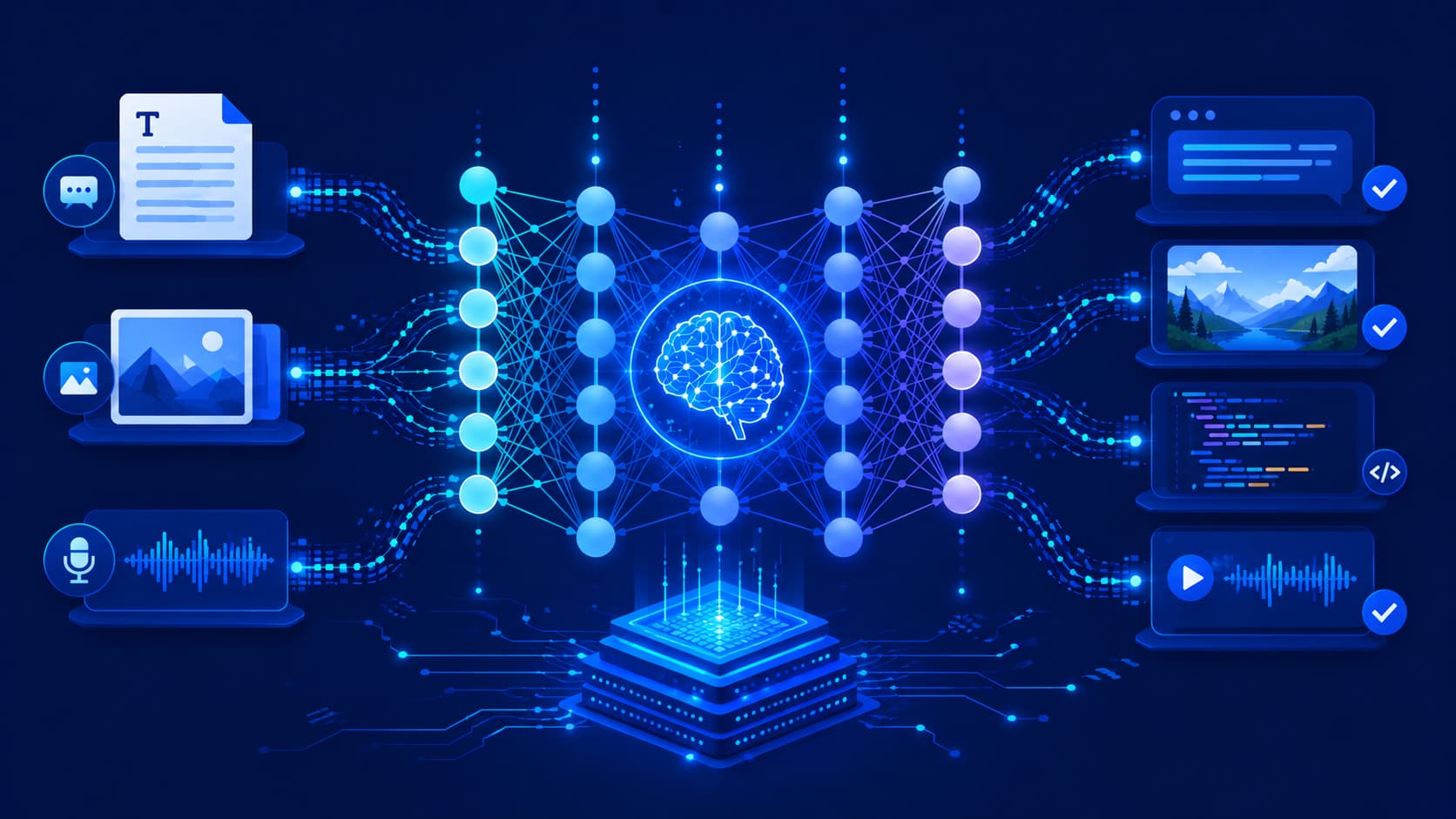
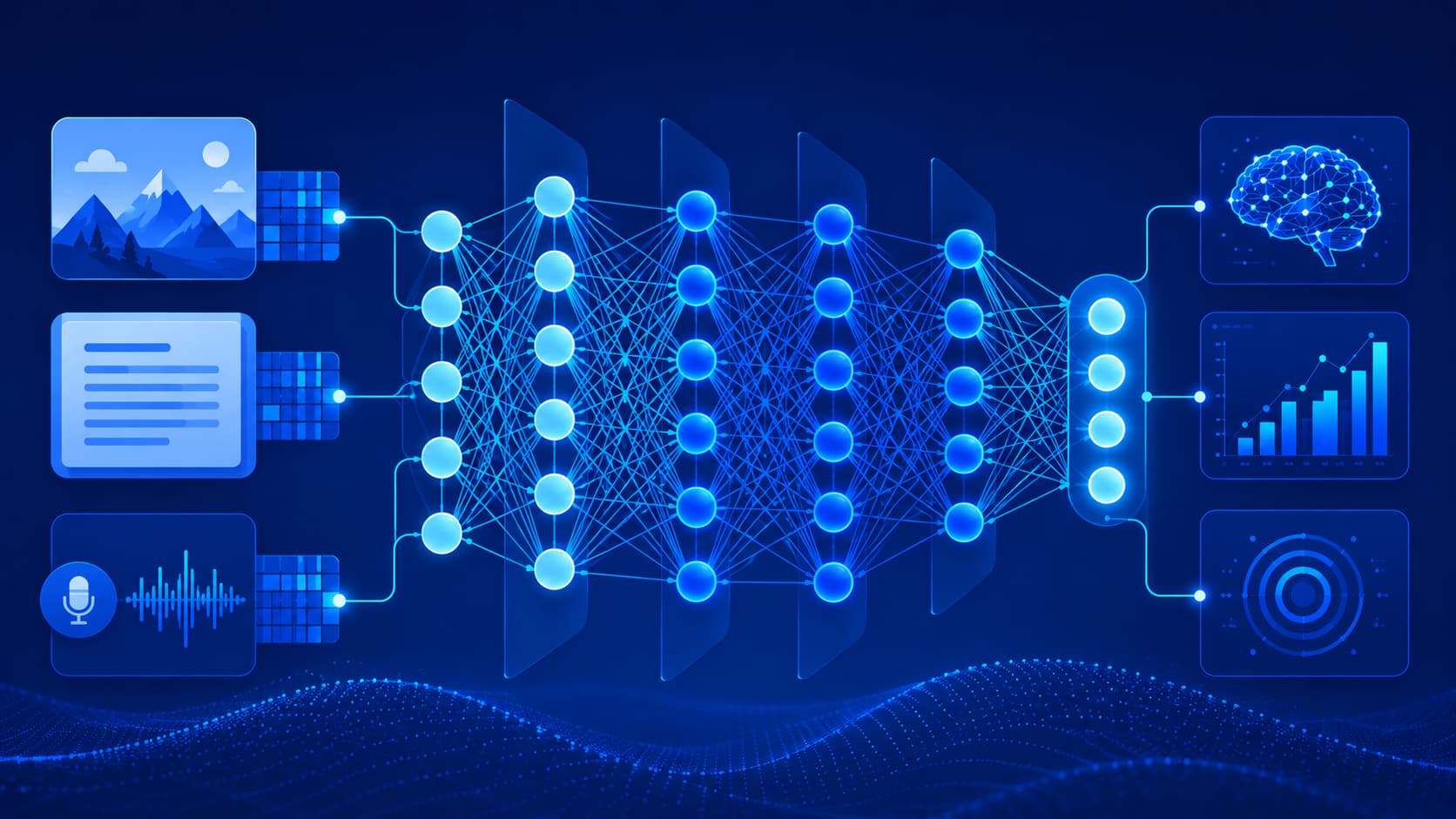
Deep learning is a specialized branch of machine learning that uses artificial neural networks with many processing layers to analyze data and solve highly complex problems.
The word deep refers to the multiple layers inside these neural networks.
Each layer gradually extracts more detailed information than the one before it.
Rather than requiring developers to manually define every rule, deep learning models automatically discover useful patterns by learning directly from enormous datasets.
This ability makes deep learning especially effective for tasks involving:
- Images.
- Speech.
- Human language.
- Video.
- Other complex forms of unstructured data.
These are areas where traditional programming rules become difficult—or even impossible—to write manually.
From Machine Learning to Deep Learning
A simple way to understand the difference is this:
- Machine learning teaches computers to learn from data.
- Deep learning teaches computers to discover increasingly sophisticated patterns within that data.
That additional ability to recognize multiple layers of patterns is what enables today's AI systems to perform tasks that once seemed impossible.
Why Deep Learning Changed AI
Earlier machine learning systems often depended on humans to tell computers which features were important.
For example, if developers wanted a computer to recognize cats in photographs, they might manually define characteristics such as:
- Pointed ears.
- Whiskers.
- Fur texture.
- Eye shape.
Deep learning takes a different approach.
Instead of relying on handcrafted rules, the model analyzes thousands—or even millions—of training examples until it learns those distinguishing features automatically.
As a result, deep learning systems can often achieve much higher accuracy on complex recognition tasks.
Editorial Insight
One of the biggest breakthroughs in deep learning wasn't simply making computers faster. It was allowing AI to discover useful features on its own instead of requiring humans to define every rule manually. That shift dramatically expanded the kinds of problems AI could solve.
Why Is It Called "Deep" Learning?
The name itself causes a surprising amount of confusion.
Many beginners assume "deep" means the AI thinks more deeply than humans.
That's not what the term means.
Instead, it refers to the structure of the neural network.
Deep learning models contain multiple processing layers, and each layer gradually transforms information into something more meaningful before passing it to the next one.
Imagine Looking at a Photograph
The source article provides a helpful analogy.
When you first glance at a photograph, you don't instantly recognize everything at once.
Instead, your understanding develops in stages:
- You notice colors and edges.
- You begin recognizing shapes.
- You identify individual objects.
- Finally, you understand the complete scene.
Deep learning models process information in a remarkably similar progression.
Learning Layer by Layer
Inside a deep neural network:
- Early layers detect simple patterns.
- Middle layers combine those patterns into more meaningful features.
- Later layers use everything learned to make a final prediction.
For example, when recognizing a face:
- Early layers may detect edges and brightness.
- Middle layers identify eyes, noses, and mouths.
- Later layers determine whose face appears in the image.
Each layer builds upon the previous one, allowing the model to solve increasingly sophisticated tasks.
Why Multiple Layers Matter
This layered approach enables deep learning to recognize patterns that would be extremely difficult to describe using traditional programming rules.
Instead of relying on a single calculation, the model gradually develops a richer understanding of the data as information moves through the network.
That's one of the main reasons deep learning performs so well in applications involving images, speech, and natural language.
Best Practice
When you hear the phrase deep learning, don't think about deeper intelligence.
Think about deeper layers of processing.
The word "deep" describes the architecture of the model—not the intelligence of the computer.
Artificial Neural Networks Explained
At the heart of every deep learning system is an artificial neural network.
Despite the name, these aren't miniature digital brains.
Instead, they're mathematical models inspired by how biological neurons connect and exchange information.
How Neural Networks Work
A neural network consists of many small processing units connected together.
Each unit performs a relatively simple task:
- Receive information.
- Perform a calculation.
- Pass the result to the next layer.
Individually, each unit is quite simple.
Collectively, however, millions—or even billions—of these small calculations allow modern AI systems to recognize remarkably complex patterns.
Small Pieces Create Powerful Systems
One processing unit alone can't recognize a face, understand speech, or generate realistic images.
But when enormous numbers of these units work together across many layers, they become capable of performing tasks that once seemed uniquely human.
The quality of a neural network generally improves when it has:
- Larger amounts of high-quality training data.
- More effective neural network architectures.
- Better training methods.
- Sufficient computing power.
These advances have played a major role in the rapid progress of artificial intelligence over the past decade.
Deep Learning vs. Machine Learning
People often use the terms machine learning and deep learning interchangeably.
Although they're closely related, they are not the same thing.
Machine learning is the broader field, while deep learning is one of its specialized branches. The relationship is similar to the one you've already learned between artificial intelligence and machine learning.
You can visualize the relationship like this:
-
Artificial Intelligence
-
Machine Learning
- Deep Learning
-
Machine Learning
Every deep learning model belongs to machine learning, but many machine learning systems do not use deep learning.
Traditional Machine Learning
Many practical machine learning applications rely on algorithms that require:
- Less training data.
- Lower computing power.
- Simpler mathematical models.
- Faster training times.
These approaches remain highly effective for many business applications, especially when datasets are relatively small or the problem doesn't require recognizing extremely complex patterns.
When Deep Learning Becomes the Better Choice
Deep learning becomes especially valuable when solving problems that involve:
- Millions of images.
- Human speech.
- Natural language.
- Video analysis.
- Massive datasets with highly complex relationships.
Instead of relying on manually selected features, deep learning automatically discovers increasingly sophisticated patterns as it processes more data.
Choosing the Right Approach
It's tempting to assume deep learning is always the better solution.
In reality, every AI problem has different requirements.
Sometimes a simpler machine learning algorithm can produce comparable results while requiring far less computing power, training time, and development effort.
The best solution depends on the nature of the problem rather than the popularity of the technology.
Editorial Insight
One of the biggest misconceptions in AI is that newer always means better. Deep learning is incredibly powerful, but it's designed for a specific class of problems. Simpler machine learning methods often remain the most practical choice when data is limited or rapid deployment is more important than maximum complexity.
Where Is Deep Learning Used?
You don't need to work in artificial intelligence to benefit from deep learning.
In fact, there's a good chance you've already interacted with multiple deep learning applications today without even realizing it. As AI has become part of everyday life, deep learning has quietly become one of the technologies powering many familiar digital experiences.
Image Recognition
One of the most recognizable examples is image recognition.
When you unlock your smartphone using facial recognition, a deep learning model analyzes your facial features and compares them with the information it learned during training.
Photo management applications also rely on deep learning to identify:
- People.
- Pets.
- Landmarks.
- Everyday objects.
These capabilities make searching and organizing large photo collections significantly easier.
Speech Recognition
Voice assistants have improved dramatically over the past decade.
Earlier systems could recognize only a limited number of predefined commands.
Modern voice assistants, however, can understand:
- Natural conversations.
- Different accents.
- Various speaking styles.
- More flexible sentence structures.
Deep learning plays a major role in making these conversations feel faster, smoother, and more natural.
Language Translation
Online translation services have also improved substantially because of deep learning.
Instead of translating individual words one at a time, modern systems analyze the context of an entire sentence before generating a translation.
This contextual understanding often produces translations that sound far more natural than older word-by-word translation methods.
Although no translation system is perfect, deep learning has made communication across languages dramatically more accessible.
Healthcare
Healthcare is another field where deep learning is making a significant impact.
Medical professionals increasingly use AI-assisted systems to support tasks such as:
- Analyzing medical images.
- Identifying potential diseases.
- Assisting medical research.
Importantly, these systems are designed to support healthcare professionals—not replace them.
AI provides an additional layer of analysis that can help improve both speed and accuracy while leaving final medical decisions to trained experts.
Autonomous Vehicles
Self-driving vehicle technology depends heavily on understanding the surrounding environment in real time.
Deep learning helps these systems recognize:
- Roads.
- Traffic signs.
- Pedestrians.
- Cyclists.
- Other vehicles.
By continuously analyzing information from cameras and sensors, deep learning enables autonomous driving systems to make informed decisions about navigation and safety.
Although fully autonomous vehicles continue to evolve, deep learning remains one of the foundational technologies behind their development.
Best Practice
One of the easiest ways to recognize deep learning is to look for applications involving human-like perception.
Whenever AI needs to understand images, speech, language, or other highly complex data, deep learning is often one of the key technologies working behind the scenes.
Why Has Deep Learning Become So Important?
Artificial intelligence has existed for decades.
So why has deep learning become one of the biggest topics in AI only during recent years?
According to the source material, the answer comes down to three major developments working together.
1. More Data
The internet has created an enormous amount of digital information.
Every day, people:
- Upload photographs.
- Publish articles.
- Watch videos.
- Communicate online.
- Use digital services.
All of this activity generates valuable training data for deep learning models.
Without these massive datasets, many modern AI systems would struggle to learn the complex patterns required for today's applications.
2. Faster Hardware
Training advanced AI models requires extraordinary computing power.
Modern GPUs and specialized AI hardware have made it possible to train models that would have been impractical only a decade ago.
As computing hardware continues to improve, researchers can build larger, more capable deep learning systems.
3. Better Algorithms
Researchers have also developed more effective neural network architectures and training techniques.
These improvements allow deep learning models to:
- Learn faster.
- Achieve higher accuracy.
- Solve increasingly complex problems.
Together, better algorithms, more data, and faster hardware have accelerated AI development at an extraordinary pace.
The Advantages of Deep Learning
Deep learning has become one of the most influential technologies in modern artificial intelligence because it offers several important advantages over many traditional approaches. Rather than relying heavily on manually designed rules, it can automatically discover complex relationships within large datasets, enabling AI systems to solve problems that were once considered extremely difficult.
It Learns Complex Patterns Automatically
One of deep learning's greatest strengths is its ability to identify intricate patterns without requiring developers to explicitly define every feature in advance.
Instead of manually programming thousands of rules, deep learning models learn directly from examples.
This makes them especially effective for applications involving:
- Image recognition.
- Speech processing.
- Natural language understanding.
- Video analysis.
- Pattern recognition.
As datasets become larger and more diverse, the model often develops an increasingly sophisticated understanding of the underlying patterns.
Performance Improves With More Data
Many traditional machine learning algorithms eventually reach a point where additional data provides only modest improvements.
Deep learning models, however, often continue improving as they learn from larger datasets.
This characteristic has become especially valuable in today's digital world, where organizations generate enormous amounts of information every day.
For example, millions of:
- Photos.
- Videos.
- Documents.
- Voice recordings.
- Customer interactions.
can provide valuable training material that helps deep learning systems become more accurate over time.
It Powers Modern AI Applications
Many of today's most impressive AI technologies depend heavily on deep learning.
According to the source material, these include:
- Large Language Models.
- AI image generators.
- Voice assistants.
- Other generative AI systems.
Without deep learning, many recent advances in artificial intelligence would not have been possible.
Editorial Insight
Deep learning became transformative not because it replaced every older AI technique, but because it dramatically expanded the kinds of problems computers could solve. Tasks involving vision, language, and speech became far more practical once AI could learn complex features directly from data.
The Challenges of Deep Learning
Despite its remarkable success, deep learning isn't the ideal solution for every problem.
Like every technology, it has important limitations that developers must consider before deciding whether it's the right approach.
High Computing Costs
Training modern deep learning models requires significant computational resources.
Large neural networks often depend on:
- Powerful GPUs.
- Specialized AI hardware.
- Large amounts of memory.
- Significant electrical power.
Building advanced models from scratch can therefore become expensive, particularly for smaller organizations with limited computing resources.
Large Data Requirements
Deep learning performs best when trained using enormous amounts of high-quality data.
If only a small dataset is available, traditional machine learning algorithms may actually produce better results while requiring far less computing power.
Choosing the appropriate approach depends on both the quantity and quality of the available data.
Limited Explainability
Another important challenge involves understanding how deep learning models reach their decisions.
Although these systems can achieve impressive accuracy, explaining exactly why a particular prediction was made is often much more difficult.
This lack of transparency becomes especially important in fields such as:
- Healthcare.
- Finance.
- Legal services.
- Scientific research.
In these industries, understanding the reasoning behind a prediction can be just as important as the prediction itself.
Researchers continue developing techniques that make deep learning systems easier to interpret while maintaining their performance.
Best Practice
Deep learning should be selected because it matches the problem—not simply because it's the newest or most advanced technology.
When data is limited or interpretability is essential, simpler machine learning methods may provide a more practical solution.
Deep Learning and Generative AI
After learning about Generative AI, many beginners naturally wonder how it relates to deep learning.
The connection is straightforward.
Generative AI relies heavily on deep learning.
Modern systems capable of generating:
- Human-like text.
- Realistic images.
- Music.
- Computer code.
- Other creative content.
are built using advanced deep learning techniques.
The Foundation Behind Modern AI
Large Language Models, image generation systems, and many other generative AI applications depend on sophisticated neural network architectures developed through deep learning research.
Without these advances, today's AI assistants would not be capable of producing:
- Natural conversations.
- High-quality written content.
- Realistic AI-generated artwork.
- Context-aware language understanding.
Deep learning provides the underlying technology that makes these capabilities possible.
Connecting the AI Hierarchy
At this point, you can see how the major AI concepts fit together:
- Artificial Intelligence is the broadest field.
- Machine Learning is one branch of AI.
- Deep Learning is a specialized branch of machine learning.
- Generative AI uses deep learning to create new content.
- Large Language Models (LLMs) are deep learning models specialized for understanding and generating human language.
Understanding this hierarchy makes it much easier to navigate AI terminology, since many of these concepts are closely connected rather than completely separate technologies.
Editorial Insight
One of the easiest ways to understand modern AI is to think of deep learning as the engine powering many of today's breakthroughs. Whether you're chatting with an AI assistant, generating an image, or translating text between languages, deep learning is often the technology making those experiences possible.
Frequently Asked Questions
Is Deep Learning the Same as Machine Learning?
No.
Deep learning is a specialized branch of machine learning that uses multi-layered artificial neural networks to solve more complex problems. While every deep learning model is a machine learning model, many machine learning systems use simpler algorithms that don't rely on deep neural networks.
Do I Need to Understand Mathematics to Learn Deep Learning?
Not at first.
You can develop a solid understanding of the core concepts without advanced mathematics.
If your goal is to build deep learning models yourself, subjects such as:
- Linear algebra.
- Calculus.
- Probability.
become increasingly important as you progress.
For beginners, however, it's often more valuable to understand what deep learning does before studying the mathematics that makes it possible.
Why Is Deep Learning So Powerful?
Deep learning's greatest strength is its ability to recognize highly complex patterns directly from enormous amounts of data.
This makes it especially effective for tasks such as:
- Image recognition.
- Speech processing.
- Natural language understanding.
Rather than relying on manually programmed rules, deep learning continuously improves its ability to identify relationships within data during training.
Is ChatGPT Based on Deep Learning?
Yes.
Large Language Models (LLMs), including those that power ChatGPT, are built using deep learning techniques and advanced neural network architectures.
Deep learning provides the foundation that enables these models to understand language, recognize context, and generate human-like responses.
Can Deep Learning Replace Traditional Machine Learning?
Not always.
For many smaller problems with limited data, traditional machine learning methods remain:
- Faster.
- Simpler.
- More practical.
Choosing between traditional machine learning and deep learning depends on the specific problem you're trying to solve, the amount of available data, and the computational resources at your disposal.
Conclusion
Deep learning has become one of the driving forces behind modern artificial intelligence.
From recognizing faces and understanding speech to generating realistic images and powering conversational AI, it enables many of the intelligent experiences people use every day.
Although the technology behind deep learning is highly sophisticated, its core principle is surprisingly straightforward.
Instead of relying on manually written rules, deep learning allows computers to discover increasingly complex patterns by learning directly from large amounts of data.
This ability has transformed artificial intelligence, making it possible for computers to solve problems that once required extensive human judgment or were considered too complex for traditional software.
As AI continues to evolve, deep learning is expected to remain at the center of many future innovations. Advances in robotics, healthcare, autonomous systems, scientific research, and generative AI will continue to build upon the foundations established by deep learning technologies.
Final Takeaway
Deep learning isn't just another AI buzzword.
It's one of the key technologies that connects many of today's most important AI concepts—from machine learning and neural networks to Large Language Models and Generative AI.
By understanding where deep learning fits within the broader AI landscape, you'll find it much easier to understand both today's AI tools and the innovations that are likely to shape the future of artificial intelligence.