Cloud computing has become so deeply integrated into our daily lives that most people rarely notice it anymore.
Every time you stream a movie, join an online meeting, save a document to the cloud, or ask an AI assistant a question, cloud infrastructure is working behind the scenes.
What's remarkable is how many different industries now depend on cloud technology.
Today, cloud computing supports:
- Personal productivity.
- Entertainment.
- Education.
- Healthcare.
- Finance.
- Software development.
- Countless other digital services.
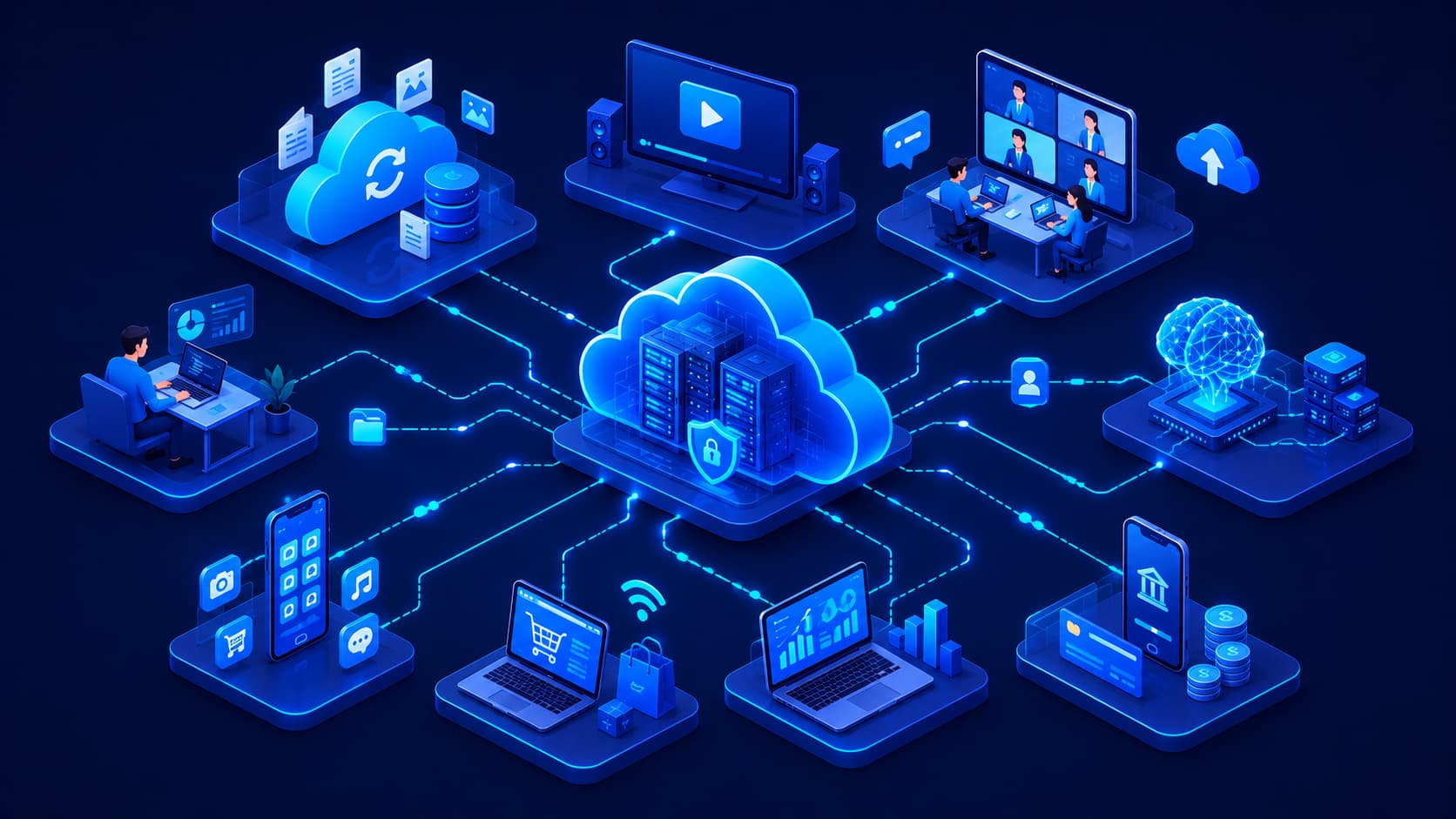
Rather than being a single application or product, cloud computing has become the technological foundation on which many modern services are built.
Understanding these real-world applications makes it much easier to appreciate why cloud computing continues to grow in importance every year.
1. Cloud Storage
One of the most familiar applications of cloud computing is online file storage.
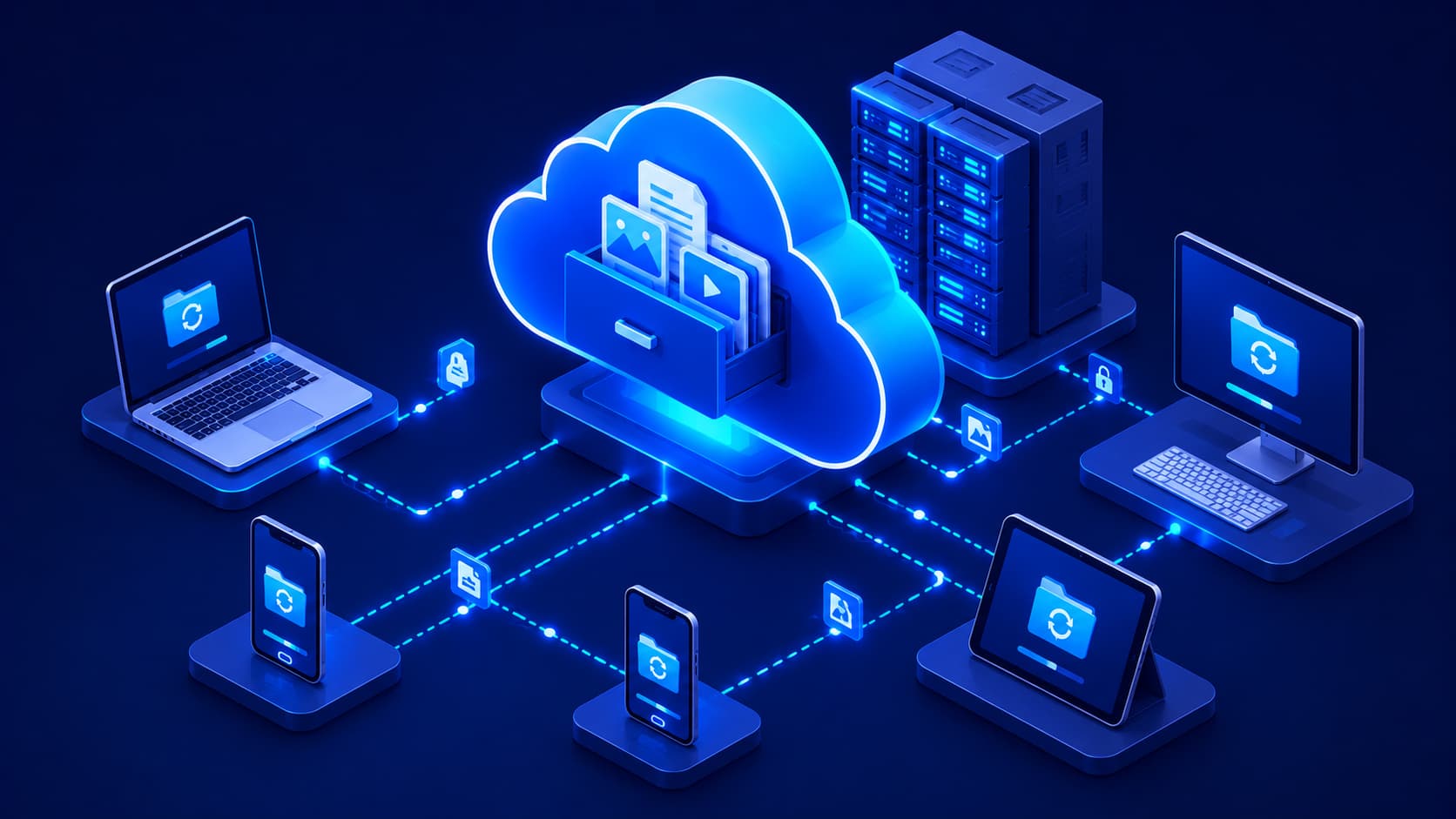
Instead of saving every file on a single computer or external hard drive, users can store documents, photos, videos, and backups on remote servers managed by cloud providers.
This allows files to be accessed from multiple devices while reducing the risk of losing important data if a computer or smartphone is damaged, lost, or replaced.
Cloud storage has become essential for both personal users and businesses because it combines:
- Convenient access.
- Automatic synchronization.
- Reliable backup capabilities.
Everyday Example
Imagine taking a photo with your phone while traveling.
A few moments later, the same image automatically appears on your tablet and laptop.
This seamless experience is possible because cloud storage continuously synchronizes your files across connected devices.
Why It's So Popular
Cloud storage eliminates many traditional storage challenges.
Users no longer need to:
- Carry USB flash drives.
- Email files to themselves.
- Worry about losing documents if a device fails.
Instead, important files remain available whenever they're needed.
Editorial Insight
Cloud storage is often the first cloud service people experience. Even users who don't realize they're using cloud computing frequently rely on it every day through smartphones, online productivity tools, and automatic device backups.
2. Video and Music Streaming
Streaming services are another excellent example of cloud computing in everyday life.
Rather than downloading large media files before watching or listening, streaming platforms deliver content over the internet from cloud infrastructure.
This allows users to enjoy:
- Movies.
- Television shows.
- Music.
- Podcasts.
almost instantly without storing every file permanently on their devices.
Behind every streaming platform is a network of servers working together to deliver content quickly and reliably to millions of users simultaneously.
Why Cloud Computing Matters
Streaming platforms experience dramatic changes in demand throughout the day.
Cloud infrastructure allows providers to automatically scale resources as more users begin watching or listening.
Without cloud computing, supporting millions of simultaneous viewers would be significantly more difficult and expensive.
Best Practice
Although streaming services rely on cloud infrastructure, users can often improve their experience by choosing appropriate video quality settings based on their internet connection. This helps reduce buffering while maintaining smooth playback.
3. Online Collaboration
Cloud computing has fundamentally changed how teams work together.
Instead of exchanging countless email attachments, multiple people can now collaborate on shared documents, spreadsheets, presentations, and project management tools in real time.
When one team member makes a change, everyone else can see the updated version almost immediately.
This real-time collaboration has become especially valuable for:
- Remote teams.
- Hybrid workplaces.
- Educational institutions.
- International organizations.
Benefits for Teams
Cloud collaboration offers several practical advantages:
- Fewer duplicate file versions.
- Faster communication.
- Improved teamwork.
- Easier document sharing.
- Better productivity across distributed teams.
By centralizing files in the cloud, organizations reduce confusion while enabling employees to work together regardless of location.
4. Email Services
Many people use cloud computing every day without realizing it simply by checking their email.
Modern email services store messages in the cloud instead of keeping them only on a single computer.
As a result, emails remain synchronized across:
- Smartphones.
- Tablets.
- Laptops.
- Desktop computers.
You can begin reading an email on one device and continue exactly where you left off on another.
Cloud-based email also simplifies:
- Data backup.
- Message search.
- Long-term storage.
making communication more reliable and accessible from virtually anywhere.
5. Artificial Intelligence
Artificial intelligence has rapidly become one of the fastest-growing applications of cloud computing.
Many AI systems require enormous computing resources that would be impractical for most individuals or businesses to own themselves.
By running these AI models in the cloud, providers can make advanced capabilities available through:
- Web browsers.
- Mobile applications.
- APIs.
- Cloud platforms.
Whether you're:
- Generating images.
- Summarizing documents.
- Translating languages.
- Chatting with an AI assistant.
cloud infrastructure is helping deliver those services in real time.
Editorial Insight
The recent growth of artificial intelligence has significantly increased the importance of cloud computing. Powerful AI models depend on large-scale cloud infrastructure, allowing millions of users to access advanced capabilities without owning specialized hardware.
6. Software Development
Cloud computing has dramatically changed the way software is built, tested, and deployed.
In the past, development teams often needed to purchase servers, configure hardware, and prepare complex environments before they could even begin building a new application.
Today, developers can create cloud-based development environments within minutes.
They can:
- Build applications.
- Test new features.
- Deploy updates.
- Scale services.
without managing physical infrastructure.
This faster development cycle allows businesses to release new products more quickly while spending less time managing servers and more time improving their applications.
Why Developers Prefer the Cloud
Cloud-based development offers several practical advantages:
- Faster environment setup.
- Consistent development platforms.
- Easier collaboration between teams.
- Simplified testing and deployment.
- Better scalability as projects grow.
These benefits help organizations accelerate software delivery while reducing operational complexity.
Editorial Insight
Modern software development is no longer limited by hardware availability. Cloud platforms enable development teams to create, test, and deploy applications almost on demand, allowing innovation to move much faster than traditional infrastructure typically permits.
7. Data Backup and Disaster Recovery
Losing important files can be frustrating, whether they contain family memories or critical business information.
Cloud computing provides a reliable way to protect valuable data by automatically creating backups in remote locations.
If a computer fails, a device is lost, or files are accidentally deleted, cloud backups can often be restored much faster than traditional recovery methods.
For businesses, disaster recovery has become an essential strategy for:
- Maintaining operations.
- Reducing downtime.
- Protecting valuable information.
- Recovering after unexpected events.
Why Backup Matters
Unexpected events happen every day.
Examples include:
- Hardware failures.
- Accidental deletion.
- Theft.
- Natural disasters.
- Malware attacks.
By storing backup copies in the cloud, organizations significantly improve their ability to recover quickly while minimizing business disruption.
Best Practice
Cloud backups should complement—not replace—a broader backup strategy. Organizations should regularly verify that backups can be restored successfully and identify which data requires additional protection based on its importance.
8. Business Applications
Many organizations now rely on cloud-based software to manage their daily operations.
Business applications commonly delivered through the cloud include:
- Customer Relationship Management (CRM).
- Accounting systems.
- Inventory management.
- Human resources software.
- Project management platforms.
Because these applications are available through the internet, employees can securely access important business information from different locations without installing complex software on every computer.
This flexibility makes cloud-based business applications suitable for organizations of all sizes.
Benefits for Organizations
Cloud business applications help organizations:
- Improve operational efficiency.
- Support remote employees.
- Simplify software updates.
- Reduce infrastructure management.
- Scale as the business grows.
Instead of maintaining multiple local installations, businesses can centrally manage applications while providing employees with secure access wherever they work.
9. Online Gaming
Cloud computing has also transformed the gaming industry.
Modern online games rely heavily on cloud infrastructure to:
- Connect players.
- Store game progress.
- Process multiplayer interactions.
- Deliver downloadable content.
Cloud gaming services extend this concept even further.
Instead of running games entirely on a local computer or gaming console, the games execute on powerful remote servers and stream the gameplay directly to users over the internet.
As internet connectivity continues to improve, cloud gaming is expected to become increasingly common.
Why Cloud Gaming Is Growing
Traditionally, playing demanding games required expensive hardware.
Cloud gaming reduces that dependency by shifting much of the processing workload to powerful cloud servers.
As a result, players can enjoy modern games on a wider range of devices without constantly upgrading their hardware.
Editorial Insight
Cloud computing is changing gaming in much the same way it transformed video streaming. Instead of relying entirely on local devices, powerful cloud infrastructure delivers demanding experiences remotely, making advanced gaming more accessible.
10. Internet of Things (IoT)
Millions of smart devices generate enormous amounts of information every day.
Examples include:
- Smart home systems.
- Wearable fitness trackers.
- Connected vehicles.
- Industrial sensors.
- Environmental monitoring equipment.
Rather than processing everything locally, these devices send data to cloud platforms where it can be:
- Stored.
- Processed.
- Analyzed.
- Visualized.
- Shared with users.
Cloud computing makes it possible to manage vast networks of connected devices efficiently while providing real-time insights and automation.
Real-World Example
A smart home may contain connected lights, security cameras, thermostats, and voice assistants.
Each device continuously exchanges information with cloud services, allowing users to monitor and control their home remotely through a smartphone application.
Without cloud computing, managing large networks of connected devices would be significantly more difficult.
Why Cloud Computing Is Used Across So Many Industries
One of the biggest reasons cloud computing has become so widespread is its versatility.
The same cloud infrastructure can support an enormous variety of applications across completely different industries.
For example:
- A university may use cloud services for online learning.
- A hospital may manage electronic medical records in the cloud.
- A retailer may operate an online store using cloud infrastructure.
- A software company may build and deploy applications through cloud platforms.
Although these organizations have different goals, they all benefit from the same core advantages of cloud computing:
- Scalability.
- Reliability.
- Accessibility.
- Reduced infrastructure management.
This flexibility is one of the primary reasons cloud computing continues to expand into new industries every year.
Why Versatility Matters
Instead of building specialized infrastructure for every business type, cloud providers offer a common technology platform that organizations can adapt to their own needs.
Whether supporting education, healthcare, finance, manufacturing, or entertainment, cloud computing provides the same fundamental capabilities while allowing businesses to build unique solutions on top of them.
Editorial Insight
Cloud computing's greatest strength isn't a single feature—it's its ability to support almost any digital workload. From personal productivity tools to enterprise systems and emerging technologies, the same cloud infrastructure powers a remarkably diverse range of applications.
Frequently Asked Questions
What Is the Most Common Use of Cloud Computing?
Cloud storage is one of the most widely used cloud services.
It allows users to store, synchronize, and access files from multiple devices through the internet.
Because it simplifies file management and improves accessibility, cloud storage has become part of everyday computing for millions of people.
Do I Use Cloud Computing Every Day?
Most likely, yes.
Many common activities rely on cloud computing, including:
- Streaming videos.
- Checking email.
- Joining online meetings.
- Using AI assistants.
- Saving files online.
Even if you never interact directly with cloud infrastructure, many of the digital services you use every day depend on it behind the scenes.
Why Do Businesses Use Cloud Computing?
Businesses commonly adopt cloud computing because it helps them:
- Reduce infrastructure costs.
- Improve scalability.
- Support remote collaboration.
- Deploy new services more quickly.
These advantages allow organizations to innovate faster while reducing the complexity of managing traditional IT infrastructure.
Is Cloud Computing Only for Large Companies?
No.
Cloud computing is used by:
- Individuals.
- Students.
- Freelancers.
- Startups.
- Small businesses.
- Large enterprises.
One of the biggest advantages of cloud services is that they can scale as users' needs grow.
This means organizations can begin with small deployments and expand gradually without making major infrastructure investments.
Will Cloud Computing Become Even More Important?
Yes.
As technologies such as:
- Artificial intelligence.
- The Internet of Things (IoT).
- Big data.
continue to evolve, cloud computing will remain one of the key technologies supporting these innovations.
Its ability to provide scalable computing resources on demand makes it an essential foundation for future digital transformation.
Conclusion
Cloud computing has become much more than simply a convenient way to store files online.
Today, it powers entertainment, communication, software development, artificial intelligence, business operations, online gaming, and billions of connected devices around the world.
Many of these services have become such a natural part of everyday life that it's easy to overlook the sophisticated cloud infrastructure supporting them behind the scenes.
Understanding these real-world applications makes it clear why cloud computing has become one of the most important technologies of the digital age.
As new technologies continue to emerge, cloud computing will continue providing the foundation for innovation across nearly every industry.
Final Takeaway
Cloud computing is no longer a specialized technology used only by IT professionals.
It has become an essential part of everyday life, supporting everything from online collaboration and entertainment to healthcare, business operations, artificial intelligence, and smart devices.
By recognizing how cloud computing is applied across different industries, you'll gain a deeper understanding of why it continues to shape modern technology—and why its importance will only continue to grow in the years ahead.