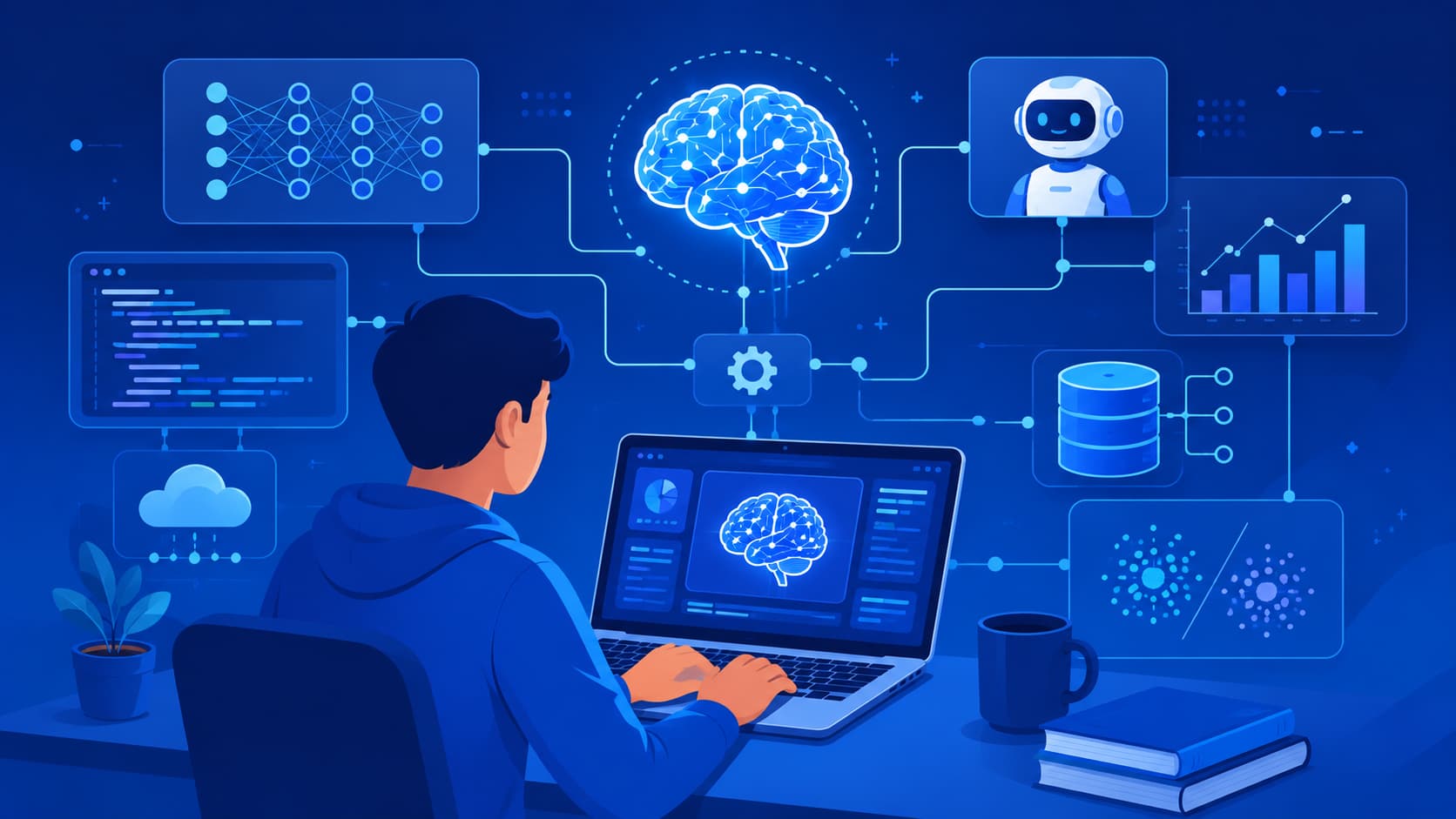
Artificial intelligence has never been more accessible than it is today. Anyone with an internet connection can access AI-powered tools, online courses, tutorials, documentation, and interactive learning platforms within minutes. Yet despite this abundance of resources, many beginners struggle to take the first step. Surprisingly, the biggest obstacle is rarely a lack of intelligence or motivation. Instead, it's the overwhelming amount of information available online.
Search for "how to learn AI," and you'll immediately find thousands of articles, YouTube videos, online courses, bootcamps, certification programs, and community discussions. Some experts recommend learning Python before anything else. Others insist that mathematics should come first. Meanwhile, many tutorials encourage beginners to start building AI applications immediately. Faced with so many conflicting recommendations, it's easy to feel overwhelmed before learning even begins.
The good news is that learning artificial intelligence doesn't have to be complicated. Like mastering any new skill, success comes from following a structured learning path rather than trying to understand everything at once. You don't need to become an AI engineer overnight, nor do you need to memorize advanced algorithms before exploring practical AI tools. Building a strong foundation first makes every advanced topic significantly easier to understand later.
Whether you're a student exploring emerging technologies, a professional looking to improve productivity, a business owner interested in automation, or simply someone curious about how AI works, choosing the right learning strategy can save months of unnecessary confusion. The objective isn't to learn everything immediately but to develop knowledge gradually while building confidence through practical experience.
In this guide, you'll discover a practical step-by-step roadmap for learning artificial intelligence, understand which skills are actually necessary, identify common mistakes beginners should avoid, and learn how to build a learning plan that matches your personal goals.
Do You Need a Technical Background?
One of the biggest misconceptions about artificial intelligence is that it's only suitable for programmers, software engineers, data scientists, or computer science graduates.
Fortunately, that's simply not true.
The learning path you should follow depends entirely on what you hope to achieve.
If your goal is to understand AI concepts and use modern AI tools effectively, you don't need a technical degree or years of programming experience. Millions of people already use AI successfully in careers completely unrelated to software development. Understanding how AI works and learning how to use it responsibly is often far more valuable than immediately learning complex programming frameworks.
AI Is Used Across Many Professions
Artificial intelligence has become a valuable productivity tool across almost every industry.
For example:
- Teachers use AI to create lesson plans and educational materials.
- Designers generate creative concepts and visual inspiration.
- Marketers brainstorm campaigns and analyze customer behavior.
- Business owners automate repetitive administrative work.
- Writers organize ideas, improve drafts, and accelerate content creation.
None of these professionals need to become AI engineers to benefit from artificial intelligence.
Instead, they focus on understanding where AI adds value, recognizing its limitations, and integrating it into their daily workflows to improve efficiency and creativity.
Practical Example
Imagine two people beginning their AI journey.
The first wants to become a machine learning engineer. They'll eventually need programming skills, mathematics, machine learning algorithms, and experience building AI models.
The second simply wants to use AI to write better reports, summarize meetings, generate marketing ideas, and automate repetitive tasks.
Although both are "learning AI," their learning paths are completely different. Neither approach is more correct—they simply serve different goals.
Editorial Insight
Many beginners postpone learning AI because they assume they aren't "technical enough."
In reality, understanding artificial intelligence today is similar to learning how to use the internet twenty years ago. Most people don't need to understand every technical detail behind web browsers, networking protocols, or search engines before they can use the internet effectively.
The same principle applies to artificial intelligence. Understanding the concepts first often provides far greater value than immediately diving into programming.
Your Goal Determines What You Should Learn
There isn't a single learning roadmap that works for everyone. The subjects you prioritize should reflect your personal interests, career objectives, and the way you intend to use artificial intelligence.
Someone planning to build AI-powered applications will eventually need to learn programming, machine learning, data processing, and AI frameworks. Meanwhile, someone focused on improving workplace productivity may spend more time learning prompt engineering, evaluating AI-generated content, selecting the right tools, and integrating AI into existing workflows.
Choosing your objective early helps eliminate unnecessary distractions and allows you to focus your learning on skills that provide the greatest long-term value.
Best Practice
Before starting your AI learning journey, ask yourself one simple question:
"Do I want to build AI systems or become highly effective at using AI?"
Answering this question early will help you create a much more focused learning roadmap while avoiding information overload.
Step 1: Understand the Basics of Artificial Intelligence
Before learning programming languages, machine learning frameworks, or advanced algorithms, it's important to understand the fundamental concepts behind artificial intelligence. These concepts provide the context needed to make sense of everything you learn later. Without a solid foundation, it's easy to memorize technical terminology without understanding how the different ideas connect.
Every beginner should feel comfortable answering several essential questions:
- What is artificial intelligence?
- How does AI learn from data?
- What's the difference between AI and machine learning?
- What are the different types of AI?
- What is generative AI?
Understanding these topics creates a mental framework that makes advanced concepts significantly easier to understand. Once you know the fundamentals, subjects such as neural networks, deep learning, prompt engineering, and large language models become much less intimidating because you already understand the bigger picture.
Practical Example
Imagine trying to learn advanced calculus before understanding basic arithmetic.
Even if you memorize formulas, you'll struggle because the foundation is missing.
Learning artificial intelligence works the same way. Mastering the basic concepts first allows every advanced topic to build naturally on knowledge you already have.
Editorial Insight
Many beginners believe learning AI means immediately writing code or training machine learning models.
In reality, understanding why AI works is far more valuable during the early stages than learning how to implement it. Strong conceptual knowledge makes future technical learning faster and far less frustrating.
Step 2: Learn How Machine Learning Fits Into AI
Once you understand the fundamentals of artificial intelligence, the next logical step is learning how machine learning fits into the broader AI ecosystem. This is where many newcomers become confused because the terms "AI" and "machine learning" are often used interchangeably, even though they describe different concepts.
Artificial intelligence is the broader field focused on building systems capable of performing intelligent tasks.
Machine learning is one of the technologies that enables those systems to improve by learning from data instead of relying entirely on manually programmed instructions. Understanding this relationship explains why modern AI has advanced so rapidly over the past decade.
At this stage, your objective isn't to build your own machine learning models.
Instead, focus on understanding how machine learning analyzes data, recognizes patterns, and generates predictions. Once these concepts become familiar, the technical aspects of AI development become much easier to approach.
Trying to write code before understanding the underlying ideas often creates unnecessary complexity and slows long-term progress.
Best Practice
Treat artificial intelligence like learning a new language.
Start by building your vocabulary before attempting complex conversations.
Likewise, build your understanding of AI concepts before moving into programming frameworks, model training, or advanced machine learning algorithms. A strong conceptual foundation will support everything you learn later.
Step 3: Decide Whether You Want to Build AI or Use AI
This is one of the most important decisions every beginner should make.
Although people often say they want to "learn AI," there are actually two very different learning paths. Choosing the right direction early can save months of studying subjects that may not be relevant to your goals.
Path 1: Building AI Applications
If your goal is to create AI-powered software, you'll eventually need to develop technical skills such as:
- Programming.
- Machine learning.
- Data processing.
- AI frameworks.
- Model training and deployment.
This learning path is well suited for aspiring AI engineers, software developers, machine learning engineers, and data scientists.
Path 2: Using AI Effectively
If your objective is improving productivity rather than building AI systems, your learning journey will look quite different.
Instead of concentrating on algorithms and programming, you'll spend more time learning how to:
- Write effective prompts.
- Evaluate AI-generated responses.
- Select appropriate AI tools.
- Integrate AI into everyday workflows.
This approach is ideal for professionals, entrepreneurs, educators, marketers, writers, designers, researchers, and anyone who wants to use AI as a productivity tool.
Neither learning path is inherently better than the other.
They simply support different objectives, and understanding which path aligns with your goals allows you to learn more efficiently while avoiding unnecessary distractions.
Practical Example
Consider two professionals.
A software developer wants to build an AI-powered customer support chatbot. They'll need to understand APIs, programming, model integration, and deployment.
A marketing manager wants AI to generate campaign ideas, improve email copy, and analyze customer feedback.
Both individuals benefit from artificial intelligence, but the knowledge each requires is significantly different.
Recognizing this difference helps beginners focus on learning what truly matters for their own goals.
Step 4: Learn Programming Only If You Need It
One of the most common questions beginners ask is:
"Do I need to learn programming before I can learn AI?"
The answer depends entirely on your long-term goal. If your objective is simply to use AI tools more effectively at work, in school, or in your daily life, the answer is no. Many professionals successfully use artificial intelligence every day without writing a single line of code. Writers generate content ideas, marketers create campaign drafts, designers explore creative concepts, and entrepreneurs automate repetitive tasks simply by learning how to communicate effectively with AI systems.
However, if you plan to build AI-powered applications, develop machine learning models, or create intelligent software, programming eventually becomes an essential skill. The encouraging news is that you don't need to master multiple programming languages immediately. Learning one language well provides a much stronger foundation than trying to learn several at once.
Why Python Is the Best Starting Point
For aspiring AI developers, Python is widely regarded as the best programming language for beginners.
Its clean syntax makes it easier to read and understand, while its extensive ecosystem includes many of the world's most popular AI and machine learning libraries. Because of these advantages, Python has become the preferred language for researchers, data scientists, software engineers, and AI developers around the world.
Instead of jumping directly into TensorFlow, PyTorch, or other advanced frameworks, focus first on understanding core programming concepts such as:
- Variables
- Functions
- Loops
- Conditional statements
- Working with files
- Basic data structures
Once these fundamentals become familiar, learning AI frameworks becomes much easier because you can concentrate on machine learning concepts instead of struggling with programming syntax.
Practical Example
Imagine two beginners learning AI development.
The first immediately starts following tutorials on neural networks without understanding basic programming concepts.
The second spends a few weeks learning Python fundamentals before exploring AI libraries.
Although the second learner appears to progress more slowly at first, they usually develop a much stronger foundation and encounter fewer obstacles when working on real AI projects.
Best Practice
If your goal is AI development, don't rush toward advanced machine learning tutorials.
Investing time in learning programming fundamentals will make future topics—including data processing, model training, neural networks, and AI deployment—significantly easier to understand.
Step 5: Don't Worry Too Much About Mathematics
Another reason many people hesitate to learn artificial intelligence is the belief that they must first master advanced mathematics.
While mathematics certainly plays an important role in AI development, it shouldn't become a barrier that prevents you from getting started. For most beginners, understanding the concepts behind artificial intelligence is far more important than immediately studying linear algebra, calculus, or probability theory.
Learn Concepts Before Equations
A useful analogy is learning to drive a car.
You don't need to understand exactly how the engine works before learning how to drive safely.
Similarly, you can understand how AI learns from data, recognizes patterns, and generates predictions long before studying the mathematical formulas behind those processes. Once your understanding grows, mathematical concepts become much easier because you'll already know why they're important.
Many experienced AI practitioners recommend learning mathematics gradually as your knowledge develops. This approach reduces unnecessary stress while making mathematical concepts more meaningful through practical experience.
Editorial Insight
One of the biggest mistakes beginners make is believing they must complete every prerequisite before touching AI.
In reality, many successful learners begin by understanding AI concepts, experimenting with modern AI tools, and gradually expanding into programming and mathematics only when those skills become necessary.
Learning this way often makes the journey more enjoyable and far less intimidating.
Step 6: Practice With Real AI Tools
Reading books, completing online courses, and watching tutorials provide valuable knowledge, but genuine understanding comes through practical experience. The fastest way to become comfortable with artificial intelligence is simply to start using it. Every interaction teaches something new about how AI interprets instructions, where it performs exceptionally well, and where human judgment is still required.
Fortunately, getting started has never been easier. Many AI tools are available directly through web browsers and mobile applications, allowing beginners to gain hands-on experience without installing complex software or purchasing expensive hardware.
Some practical ways to learn include:
- Asking questions about unfamiliar topics.
- Summarizing lengthy articles or reports.
- Brainstorming creative ideas.
- Rewriting emails in a more professional tone.
- Translating content into different languages.
- Organizing meeting notes.
- Experimenting with different prompts and comparing the results.
As you continue experimenting, you'll discover one of the most important lessons about AI: it's incredibly powerful, but it isn't perfect. Developing the ability to recognize both its strengths and limitations is one of the most valuable skills any beginner can acquire.
Best Practice
Don't treat AI as a tool that simply provides answers.
Treat it as a learning partner.
Ask follow-up questions, request alternative explanations, compare different responses, and verify important information using trusted sources. Active experimentation will help you develop a much deeper understanding than passive reading alone.
Step 7: Build Small Projects
If your goal is to become an AI developer, don't wait until you feel like an expert before creating something.
One of the most effective ways to learn artificial intelligence is by building small, practical projects. Applying what you've learned helps transform theoretical knowledge into real-world experience, making new concepts easier to understand and remember.
Start With Simple Projects
Your first AI project doesn't need to be revolutionary.
In fact, simple projects are often the most valuable because they allow you to focus on learning fundamental concepts without becoming overwhelmed by unnecessary complexity.
Some beginner-friendly project ideas include:
- A basic chatbot.
- A text summarizer.
- An image classifier.
- A recommendation system.
Each of these projects introduces important AI concepts while remaining manageable for someone who is still developing their technical skills.
Progress Comes Through Practice
Every project teaches lessons that books and tutorials alone cannot provide.
As you write code, test your application, encounter errors, and improve your solutions, you'll naturally develop problem-solving abilities that are essential for long-term success in AI development. Even projects that don't work perfectly provide valuable learning experiences because they reveal how different AI components interact in practical situations.
Remember that your early projects are not expected to be perfect.
Their purpose is to help you gain confidence, reinforce your understanding, and gradually prepare you for larger, more sophisticated applications.
Practical Example
Suppose you've just learned the basics of Python and prompt engineering.
Instead of attempting to build a complete AI assistant similar to ChatGPT, start with a simple application that summarizes text or answers questions about a small document.
Completing several small projects like this will teach you far more than spending months trying to build an overly ambitious application that never reaches completion.
Best Practice
Focus on consistency rather than perfection.
Completing five small projects usually provides more practical experience than spending the same amount of time attempting one complex project that becomes too difficult to finish.
Common Mistakes Beginners Make
Learning artificial intelligence is an exciting journey, but beginners often encounter similar obstacles. Fortunately, most of these challenges aren't caused by a lack of intelligence—they're the result of unrealistic expectations or ineffective learning habits.
Recognizing these common mistakes early can save considerable time and frustration while helping you build stronger learning habits.
Trying to Learn Everything at Once
Artificial intelligence is an enormous field.
It includes machine learning, deep learning, computer vision, natural language processing, robotics, generative AI, reinforcement learning, data science, and many other specialized disciplines. Attempting to master all of these topics simultaneously usually creates confusion instead of meaningful progress.
A more effective strategy is to study one concept at a time, building confidence with the fundamentals before gradually moving into more advanced subjects.
Skipping the Fundamentals
Many beginners immediately search for advanced tutorials because they want to build impressive AI applications as quickly as possible.
Although this enthusiasm is understandable, skipping foundational concepts often makes advanced topics significantly harder to understand later.
Learning how artificial intelligence works, how machine learning fits into AI, and why data matters creates a foundation that supports every future skill you'll develop.
Collecting Courses Without Practicing
Purchasing online courses, bookmarking tutorials, and saving educational videos can feel productive.
However, genuine learning happens when you apply what you've studied.
Reading about AI is valuable, but practical experience transforms knowledge into understanding. Even simple exercises—such as experimenting with prompts, summarizing documents with AI, or building a small chatbot—provide experience that passive learning simply cannot replace.
Comparing Yourself to Experts
Watching experienced AI engineers or researchers can sometimes make beginners feel discouraged.
Remember that every expert once started from exactly the same place.
Instead of comparing yourself with people who may have years of experience, focus on becoming slightly better every day. Consistent improvement over time almost always produces better long-term results than trying to progress as quickly as possible.
Editorial Insight
Artificial intelligence is evolving rapidly, and even experienced professionals continue learning every year.
You don't need to know everything to begin. What matters most is developing a habit of continuous learning and staying curious as the technology evolves.
A Simple Learning Roadmap
If you're unsure how to organize your learning journey, following a structured roadmap can make the entire process much more manageable. Rather than jumping randomly between tutorials, each step should build naturally upon the previous one, helping you develop both confidence and practical understanding.
A beginner-friendly roadmap could look like this:
- Understand what artificial intelligence is.
- Learn how machine learning fits into AI.
- Explore generative AI and popular AI tools.
- Decide whether you want to build AI or primarily use AI.
- Learn Python if your goal is AI development.
- Practice using AI in real-world situations.
- Build small projects.
- Continue learning as new technologies emerge.
Following a logical sequence like this reduces information overload while helping you understand how different AI concepts connect with one another.
Learn at Your Own Pace
Everyone learns differently.
Some people learn best through experimentation, while others prefer structured courses, books, or video tutorials.
The important thing isn't how quickly you complete your roadmap.
What truly matters is maintaining consistent progress. Learning a little each week over several months is usually far more effective than rushing through advanced topics without fully understanding them.
Best Practice
Instead of measuring your success by the number of courses you've completed, measure it by what you can actually explain, apply, or build.
Practical understanding is always more valuable than simply collecting certificates.
Frequently Asked Questions
How long does it take to learn artificial intelligence?
The answer depends entirely on your goals.
If you simply want to understand AI fundamentals and use AI tools effectively, you can build a solid foundation within a few weeks of consistent study. Becoming an AI engineer or machine learning specialist, however, typically requires months—or even years—of continued learning, hands-on practice, and real-world experience.
Is Python required for learning AI?
Not necessarily.
If your goal is to use AI tools effectively, programming isn't required.
However, if you plan to build AI applications or develop machine learning systems, Python remains the most widely used programming language because of its simplicity and extensive AI ecosystem.
Can I learn AI without a computer science degree?
Absolutely.
People from business, education, healthcare, marketing, design, finance, and many other industries successfully learn and use artificial intelligence every day.
Curiosity, consistency, and practical experience often matter just as much as formal academic qualifications.
Conclusion
Learning artificial intelligence doesn't have to be overwhelming. For most beginners, the biggest challenge isn't technical ability—it's knowing where to start. By building a strong foundation, following a structured roadmap, practicing consistently, and learning at a pace that matches your goals, you can develop meaningful AI skills without becoming overwhelmed.
Whether you want to build AI-powered applications or simply use AI to improve your daily productivity, the most important step is to begin. You don't need to know everything on your first day. Every article you read, every AI tool you explore, and every project you complete contributes to a deeper understanding of one of today's most transformative technologies.
Final Takeaway
Artificial intelligence is a broad and rapidly evolving field, but learning it doesn't require mastering everything at once.
Start by understanding the fundamentals, choose a learning path that aligns with your personal goals, gain hands-on experience through practical projects, and continue improving through consistent practice.
Small, steady progress over time will build far stronger AI skills than trying to learn everything as quickly as possible. With the right mindset and a structured roadmap, anyone can begin their AI learning journey with confidence.