As software grows, writing code becomes only part of the challenge. Keeping that code organized is often even more difficult. A small program containing a few hundred lines may be easy to understand, but large applications with hundreds of thousands—or even millions—of lines of code require a structured approach to remain maintainable. Without clear organization, adding new features becomes risky, fixing bugs takes longer, and understanding someone else's code becomes increasingly frustrating.
To solve this problem, software development evolved beyond simply writing instructions for computers. Developers also needed better ways to organize those instructions. One of the most influential solutions is Object-Oriented Programming (OOP). Rather than treating a program as one long sequence of instructions, OOP organizes software into independent objects that represent real-world concepts and interact with one another. This approach makes complex software easier to understand, expand, and maintain over time.
What Is Object-Oriented Programming?
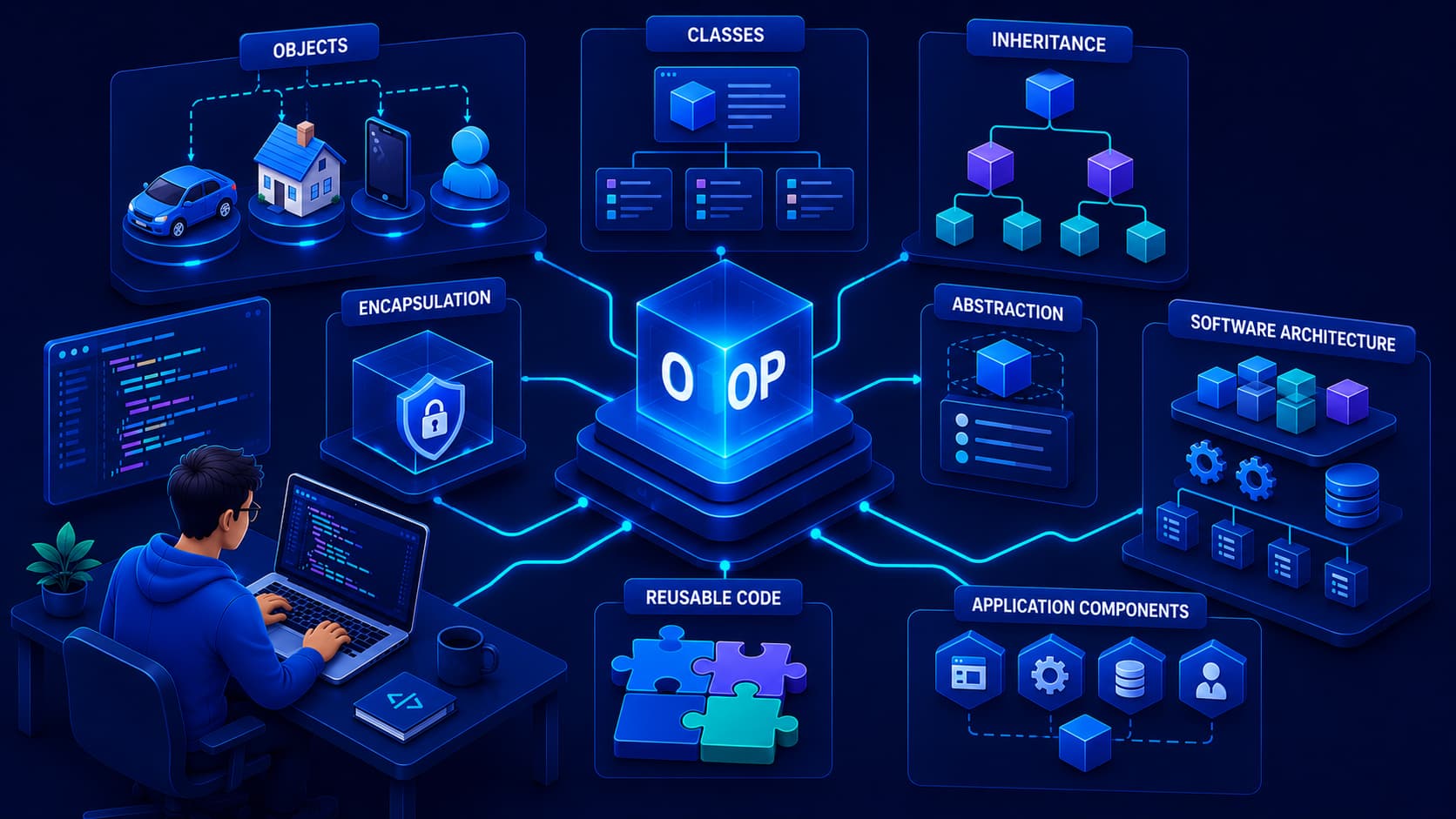
Object-Oriented Programming (OOP) is a programming paradigm that organizes software around objects instead of focusing only on functions or procedures. Each object combines two essential components:
- Data, which describes the object's state.
- Behavior, which defines what the object can do.
Consider a car in a software application. The car might contain information such as its color, model, and current speed. At the same time, it can perform actions like starting the engine, accelerating, braking, or turning. Instead of separating these pieces of information into unrelated parts of the program, OOP groups them together inside a single object. This makes software easier to understand because objects often resemble real-world things that people already recognize.
Practical Example
Imagine you're building an online shopping application.
Instead of storing customer names, email addresses, shopping carts, and order histories in unrelated variables and functions, OOP allows you to create a Customer object. That object contains both the customer's information and the actions they can perform, such as logging in, updating their profile, or placing an order. Organizing related data and behavior together makes the software cleaner and easier to maintain as the application grows.
Editorial Insight
One reason OOP became so successful is that it mirrors the way humans naturally think about the world. We understand concepts like cars, customers, products, and employees as individual entities with both characteristics and behaviors. OOP brings this same perspective into software development.
What Is a Class?
If objects represent individual items, then a class acts as the blueprint used to create them. A useful analogy is a house blueprint. The blueprint describes how a house should be built, but it is not a house itself. Many different houses can be constructed using the same blueprint. Programming works in exactly the same way.
A class defines:
- The properties an object should have.
- The behaviors the object can perform.
Every object created from a class is called an instance.
For example, a Car class might define properties such as:
- Color
- Speed
- Model
It might also define behaviors such as:
- Start
- Stop
- Accelerate
Using that blueprint, one object could represent a blue sedan, while another represents a red sports car. Although both share the same class, each object stores its own unique values.
Best Practice
Think of a class as a reusable template rather than a single object. By designing classes carefully, developers can create many independent objects without rewriting the same code repeatedly.
Why Was OOP Created?
As software projects became larger, developers needed better ways to organize increasingly complex codebases. Earlier programming approaches often scattered related logic across numerous files, making applications harder to understand and modify over time.
Object-Oriented Programming addressed this challenge by grouping related information and functionality together. Instead of thinking about isolated functions, developers could think in terms of objects that collaborate to accomplish tasks. This organization improves readability, simplifies maintenance, and encourages code reuse across large software projects.
As teams grow and applications become more sophisticated, this structured approach helps developers work more efficiently while reducing the risk of introducing bugs when new features are added.
The Four Core Principles of OOP
Object-Oriented Programming is built upon four fundamental principles. Although these concepts may seem technical at first, each exists to make software easier to design, understand, and maintain.
In the next section, we'll explore each principle—Encapsulation, Inheritance, Polymorphism, and Abstraction—and see how they help developers build flexible and scalable applications.
The Four Core Principles of OOP
The four core principles of Object-Oriented Programming provide the foundation for designing software that is organized, maintainable, and scalable. Although they introduce new terminology, each principle solves a practical problem that developers encounter when building real-world applications.
Encapsulation
Encapsulation is the practice of keeping related data and behavior together while limiting direct access to an object's internal state. Instead of allowing other parts of a program to freely modify an object's data, the object controls how its information can be accessed or changed. This approach helps prevent unexpected errors and improves software reliability.
A useful analogy is a car. Drivers interact with the steering wheel, pedals, and dashboard controls without needing direct access to the engine or transmission. The complex internal mechanisms remain protected behind a simple and safe interface.
Practical Example
Consider a BankAccount object.
Instead of allowing other parts of the application to change the account balance directly, the object provides methods such as deposit() and withdraw(). These methods can validate transactions before updating the balance, reducing the likelihood of invalid or inconsistent data.
Inheritance
Inheritance allows one class to build upon another. Rather than creating every class from scratch, developers can define a new class that automatically inherits the properties and behaviors of an existing one.
For example, an Animal class might define common characteristics such as eating and sleeping. More specific classes, such as Dog and Cat, inherit those shared characteristics while introducing behaviors unique to each type of animal.
Inheritance encourages code reuse, reduces duplication, and makes large software projects easier to maintain because common functionality only needs to be written once.
Editorial Insight
Inheritance should be used when there is a genuine "is-a" relationship between classes. Creating inheritance simply to reuse code can make software harder to understand. Experienced developers carefully consider whether inheritance or another design technique is the better choice for a particular situation.
Polymorphism
Polymorphism allows different objects to respond to the same action in different ways. Multiple objects may support the same method, yet each performs that method according to its own implementation.
For example, several vehicle objects might all support a start() method:
- A gasoline car starts its engine.
- An electric car powers up its battery system.
- A motorcycle follows its own startup process.
Although each object responds differently, the application can interact with all of them using the same action. This flexibility allows developers to extend software without changing existing code.
Best Practice
Polymorphism becomes especially valuable in large applications because it allows new functionality to be added with minimal impact on existing components. This reduces maintenance effort and makes software easier to evolve over time.
Abstraction
Abstraction focuses on hiding unnecessary complexity while exposing only the features that users or developers need. Rather than requiring people to understand every internal process, abstraction provides a simpler interface for interacting with complex systems.
A smartphone is a familiar example. Users tap buttons, open applications, and navigate menus without needing to understand how the operating system manages memory, communicates with hardware, or processes network requests. All of that complexity remains hidden behind an intuitive interface.
Programming follows the same principle by allowing developers to work with high-level concepts while the implementation details remain concealed.
Why OOP Is Popular
Object-Oriented Programming has remained popular for decades because it helps developers manage increasingly complex software systems. As applications grow larger, organizing code into well-defined objects makes projects easier to understand, maintain, and expand.
Some of the biggest advantages of OOP include:
- Improved code organization.
- Better code reuse.
- Easier maintenance.
- Greater scalability for large applications.
- Simplified collaboration between development teams.
Instead of building one enormous block of code, developers divide software into smaller, independent components that work together. This modular approach simplifies testing, debugging, and future enhancements while making projects easier for multiple developers to manage simultaneously.
Is OOP Used Everywhere?
Object-Oriented Programming is extremely common, but it is not the only programming paradigm available. Many modern programming languages support multiple programming styles, allowing developers to choose the approach that best fits their project.
Some projects benefit from:
- Functional programming.
- Procedural programming.
- Event-driven programming.
In practice, many popular programming languages combine several paradigms rather than requiring developers to use only one. The important takeaway is that OOP is a powerful tool, but it is not the only solution. Experienced developers evaluate each project's requirements before deciding which programming approach is most appropriate.
Programming Languages That Support OOP
Many of today's most widely used programming languages support Object-Oriented Programming. Some were designed with OOP as their primary programming model, while others gradually introduced object-oriented features as they evolved. Regardless of their history, the core concepts remain remarkably consistent across languages.
Common programming languages that support OOP include:
- Java
- C#
- Python
- PHP
- C++
- Kotlin
- Swift
Although each language has its own syntax and conventions, they all implement the same fundamental ideas:
- Classes
- Objects
- Encapsulation
- Inheritance
- Polymorphism
- Abstraction
Learning these concepts makes it much easier to transition between programming languages because you're building transferable problem-solving skills rather than memorizing language-specific syntax.
Editorial Insight
Many beginner programmers worry about choosing the "perfect" language. In reality, understanding OOP concepts is often more valuable than mastering the syntax of any single language. Once you understand how objects and classes work, adapting to another object-oriented language becomes significantly easier.
Common Misconceptions About OOP
Like many programming concepts, Object-Oriented Programming is sometimes misunderstood by beginners. Understanding what OOP is—and what it isn't—helps developers apply it more effectively.
OOP Is Not a Programming Language
Object-Oriented Programming is not a programming language. It is a programming paradigm, which means it is a way of organizing and designing software. Many programming languages support OOP, but OOP itself exists independently of any particular language.
Bigger Classes Are Not Better
Some beginners assume that larger classes are more powerful because they contain more functionality. In practice, the opposite is often true. Smaller classes with clearly defined responsibilities are usually easier to understand, test, maintain, and reuse.
Best Practice
A good class should have a single, well-defined responsibility. Keeping classes focused on one purpose makes applications more modular, simplifies debugging, and reduces the impact of future changes.
OOP Doesn't Solve Every Problem
Although Object-Oriented Programming is one of the most widely used programming paradigms, it is not always the best solution. Some projects are better suited to procedural, functional, or event-driven programming depending on their specific requirements. Understanding OOP is important, but knowing when to use it is equally valuable.
Frequently Asked Questions
What Is Object-Oriented Programming in Simple Terms?
Object-Oriented Programming is a way of organizing software into objects that combine related data and behavior. This structure makes applications easier to build, understand, and maintain.
What's the Difference Between a Class and an Object?
A class is a blueprint that defines properties and behaviors, while an object is an individual instance created from that blueprint. Multiple objects can be created from the same class, each containing its own unique data.
Is OOP Difficult to Learn?
The fundamental concepts of OOP are relatively straightforward. Applying those concepts effectively in large software projects takes practice, but beginners can understand the core principles without extensive programming experience.
Do All Programming Languages Use OOP?
No.
Many programming languages support Object-Oriented Programming, but others emphasize different paradigms such as procedural or functional programming. In fact, several modern languages allow developers to combine multiple programming styles within the same project.
Is OOP Still Relevant Today?
Yes.
Object-Oriented Programming continues to play an important role in enterprise software, web development, mobile applications, desktop software, and many other areas of software engineering. It remains one of the foundational concepts taught to aspiring developers.
Conclusion
Object-Oriented Programming transformed the way developers build software by organizing code into reusable, well-defined objects. Instead of viewing applications as one long sequence of instructions, OOP encourages developers to model real-world concepts through classes and objects that work together.
Its four core principles—encapsulation, inheritance, polymorphism, and abstraction—help make software more organized, maintainable, reusable, and scalable. While OOP is not the only programming paradigm available, understanding its concepts provides a strong foundation for modern software development and makes it easier to work with many popular programming languages.
As you continue your programming journey, you'll encounter OOP in countless real-world applications. Mastering these concepts will prepare you for building everything from small personal projects to large enterprise systems.
Final Takeaway
Object-Oriented Programming is more than just a programming technique—it's a structured way of thinking about software design.
Keep these key lessons in mind:
- Think in terms of objects that represent real-world concepts.
- Use classes as reusable blueprints for creating objects.
- Apply the four core principles to build cleaner and more maintainable software.
- Design classes with clear, focused responsibilities.
- Remember that OOP is a powerful tool, but not the only programming paradigm available.
By developing a solid understanding of Object-Oriented Programming, you'll build a foundation that supports learning advanced software architecture, design patterns, frameworks, and large-scale application development.