After writing a program, there is still one essential step before a computer can execute it: the source code must be translated into instructions that the processor understands. In the previous article, we explored how programming languages act as a bridge between human-readable code and machine instructions. The next logical question is how that translation actually happens.
The answer depends on the programming language. Some languages translate the entire program before it runs, while others translate code as the program is already executing. These two approaches are commonly known as compiled and interpreted languages. Although both accomplish the same goal, they do so in different ways, each with its own strengths and trade-offs.
Understanding these approaches helps explain why some applications require a build process before running, why others can be executed immediately, and why software performance varies between programming languages.
What Is a Compiler?
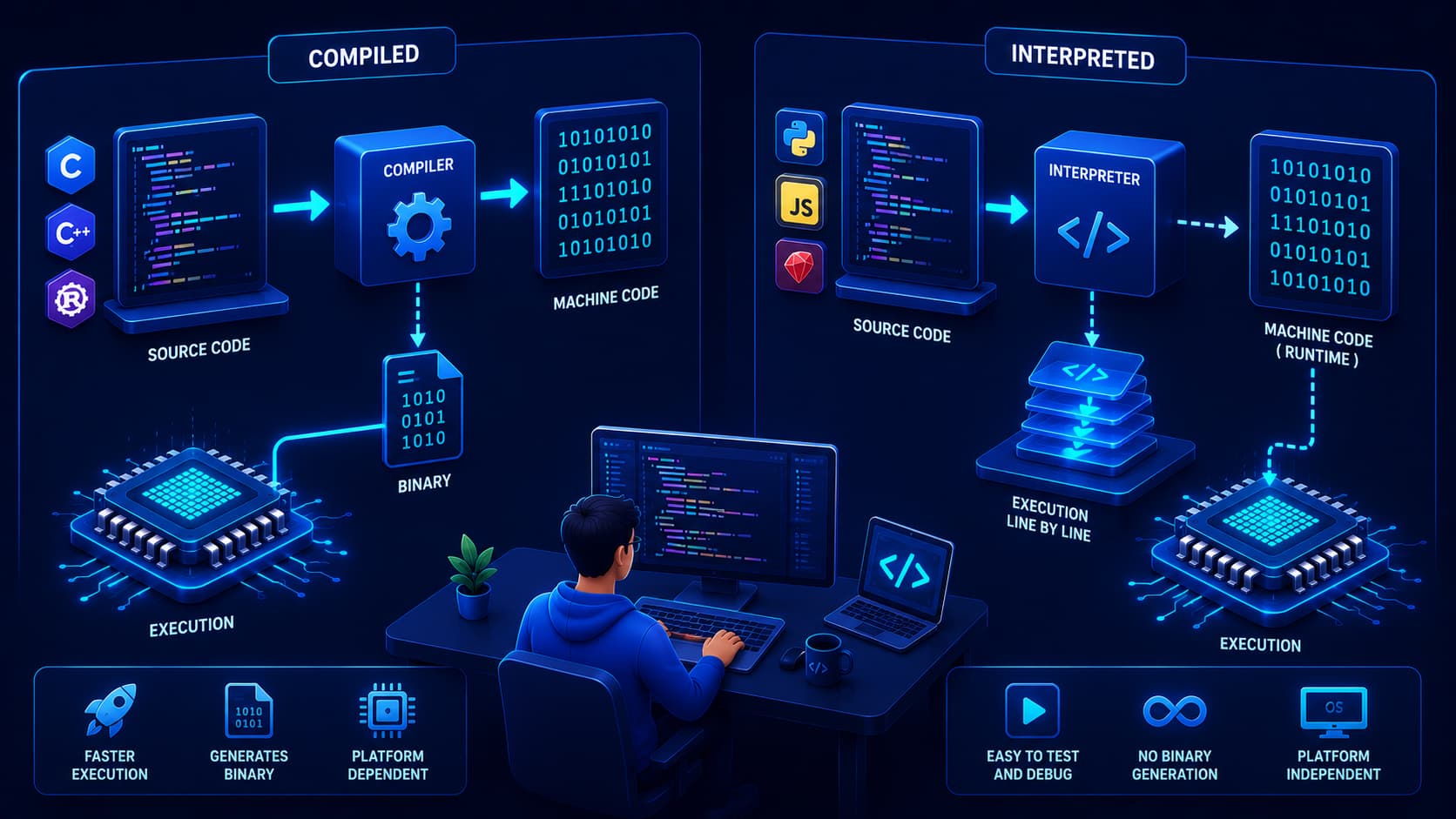
A compiler is a program that translates an entire source code file into machine code before the program is executed. Rather than processing instructions one at a time, the compiler analyzes the complete program and generates an executable file or another machine-readable format.
Once compilation is complete:
- The executable can often run without the original source code.
- The translation process does not need to occur every time the application starts.
- Programs usually launch quickly because the machine code has already been generated.
The primary drawback is that whenever developers modify the source code, they typically need to compile the program again before testing the latest version.
Practical Example
Imagine you're developing a desktop application in a compiled language. After making changes to the code, you click Build or Compile. The compiler processes the entire project and produces a new executable file. Only after this step can you run the updated application.
What Is an Interpreter?
An interpreter follows a different strategy. Instead of translating the entire program in advance, it reads the source code and executes it step by step while the program is running.
This approach offers several advantages for developers:
- Code changes can often be tested immediately.
- There's usually no need to create a separate executable after every modification.
- Experimentation becomes faster and more convenient.
- Debugging is often easier during development.
Because translation occurs during execution, some interpreted programs may run more slowly than compiled applications. However, the faster development workflow often outweighs this trade-off for many types of projects.
Editorial Insight
It's important to distinguish development speed from execution speed. Interpreted languages may execute more slowly in some situations, but they often allow developers to build, test, and improve software much more quickly. For many business applications, faster development delivers greater value than achieving the highest possible execution performance.
Why Do Both Approaches Exist?
If compiled programs are frequently faster, you might wonder why interpreted languages continue to be widely used. The reason is simple: performance isn't the only factor that matters. Modern software development also depends on productivity, flexibility, portability, and ease of testing.
Compiled languages often excel in situations where efficiency is critical, including:
- Operating systems.
- Game engines.
- Performance-intensive applications.
Interpreted languages are commonly chosen for:
- Scripting.
- Automation.
- Web development.
- Data analysis.
- Rapid prototyping.
Neither approach is universally superior. Each exists because different software projects have different priorities, and the best choice depends on the specific requirements of the application being developed.
It's Not Always Black and White
A common misconception is that every programming language is either compiled or interpreted. In reality, modern software development is much more flexible. Many languages combine both techniques, while others first compile source code into an intermediate format before executing it through a virtual machine or runtime environment.
As a result, the distinction between compiled and interpreted languages is no longer as strict as it once was. Rather than memorizing rigid categories, it's more valuable to understand the general execution model behind each approach and the reasons they exist.
Editorial Insight
Modern programming languages are designed to balance performance, portability, and developer productivity. This is why many popular languages don't fit neatly into a single category. Instead, they combine multiple technologies to achieve the best overall development experience.
Advantages of Compiled Languages
Because compilation happens before execution, compiled programs often achieve excellent runtime performance. Since the processor can execute machine code directly, there is no need to translate instructions while the application is running.
Some of the primary advantages include:
- Faster execution in many scenarios.
- Better optimization during the compilation process.
- More direct access to hardware resources when required.
- Well suited for large applications where performance is a top priority.
These characteristics make compiled languages a popular choice for building:
- Operating systems.
- Game engines.
- Embedded systems.
- Other performance-critical software.
Practical Example
Applications such as game engines or real-time graphics software often perform millions of calculations every second. In these situations, even small performance improvements can make a noticeable difference, making compiled languages an attractive option.
Advantages of Interpreted Languages
Interpreted languages prioritize flexibility and developer productivity. Because developers can usually run code immediately after making changes, testing and debugging become significantly faster. This rapid feedback loop is especially valuable during the early stages of software development.
Some common advantages include:
- Faster development and testing.
- Easier debugging because code changes can be tested immediately.
- Greater flexibility for scripting and automation.
- Better portability across operating systems when the appropriate runtime is available.
These strengths have made interpreted languages widely used in:
- Web development.
- Automation.
- Data analysis.
- Artificial intelligence.
Best Practice
For beginners, interpreted languages often provide a smoother learning experience because you can modify code and immediately see the results. This quick feedback encourages experimentation and helps reinforce programming concepts more effectively.
Which Approach Is Better?
This is one of the first questions many new programmers ask. The answer is straightforward: neither approach is universally better. Each has strengths that make it suitable for different situations.
If maximum performance is the highest priority, a compiled language may be the better choice. On the other hand, if rapid development, experimentation, and flexibility are more important, an interpreted language may offer significant advantages.
Professional software teams rarely choose a programming language based solely on whether it is compiled or interpreted. They also evaluate factors such as:
- Project requirements.
- Available libraries and development tools.
- Community support.
- Long-term maintenance.
- Team experience.
- Deployment environment.
Ultimately, the translation method is just one consideration among many. Successful software projects depend on selecting technologies that align with the project's overall goals rather than focusing on a single technical characteristic.
Examples of Popular Languages
Although modern programming language implementations continue to evolve, the following examples illustrate the general distinction between compiled and interpreted execution models.
Languages commonly associated with compilation include:
- C
- C++
- Rust
- Go
Languages commonly associated with interpretation include:
- Python
- JavaScript
- Ruby
- PHP
Some programming languages, such as Java and C#, combine compilation with virtual machines or managed runtime environments. These examples demonstrate that modern programming languages don't always fit neatly into a single category. Understanding how a language executes code is generally more valuable than simply memorizing labels.
Editorial Insight
As you continue learning programming, you'll notice that experienced developers rarely choose a language solely because it is compiled or interpreted. Instead, they evaluate how well the language fits the project's goals, available tools, ecosystem, and long-term maintenance requirements.
Why Beginners Should Understand This Concept
You don't need to become an expert on compilers or interpreters before writing your first program. However, understanding how code is executed provides valuable context for many concepts you'll encounter later in your programming journey.
For example, this knowledge helps explain:
- Why some applications require a build step before they can run.
- Why syntax errors are sometimes detected immediately.
- Why software performance differs between programming languages.
- Why developers use different debugging techniques depending on the language.
As your programming skills grow, these concepts become increasingly useful for understanding software architecture, development tools, and language design.
Best Practice
Rather than worrying about whether your first language is compiled or interpreted, focus on learning programming fundamentals such as variables, control flow, functions, and problem-solving. These core concepts transfer across virtually every modern programming language.
Frequently Asked Questions
Is a Compiled Language Always Faster?
Not necessarily.
Compiled languages often provide excellent performance, but many other factors also affect how quickly a program runs. Algorithms, compiler optimizations, hardware capabilities, and runtime behavior all influence overall performance.
Is Python an Interpreted Language?
Python is generally described as an interpreted language because its code is executed by the Python interpreter. However, modern implementations may perform intermediate compilation behind the scenes before execution.
Is Java a Compiled Language?
Java uses a hybrid approach. Its source code is first compiled into bytecode, which is then executed by the Java Virtual Machine (JVM). This combines characteristics of both compilation and interpretation.
Should Beginners Start with a Compiled or Interpreted Language?
Either approach is suitable.
What's most important is learning the fundamentals of programming rather than focusing on how a language executes code. The core concepts you learn will transfer to many different programming languages throughout your career.
Will Understanding Compilers Make Me a Better Programmer?
Yes.
You don't need in-depth knowledge of compiler design, but understanding how programs are translated and executed helps explain topics such as debugging, performance, portability, and software architecture.
Conclusion
Compiled and interpreted languages represent two different approaches to solving the same challenge: transforming human-readable source code into instructions that computers can execute. Compiled languages typically emphasize performance by translating programs before execution, while interpreted languages prioritize flexibility by translating code as it runs.
Modern programming languages frequently combine these techniques, making the distinction less rigid than it was in the past. Instead of asking which approach is universally better, it's more helpful to understand the strengths of each and recognize that different software projects have different technical and business requirements.
Final Takeaway
Compiled and interpreted languages are not competitors—they are different solutions to the same fundamental problem: converting human-readable source code into executable machine instructions.
Keep these key ideas in mind:
- Compilers translate an entire program before execution.
- Interpreters execute code while it is running.
- Both approaches have advantages and trade-offs.
- Modern programming languages often combine multiple execution techniques.
- Choosing a programming language depends on project requirements, not just execution speed.
By understanding these concepts, you'll have a stronger foundation for learning programming languages and be better prepared to explore more advanced topics in software development.