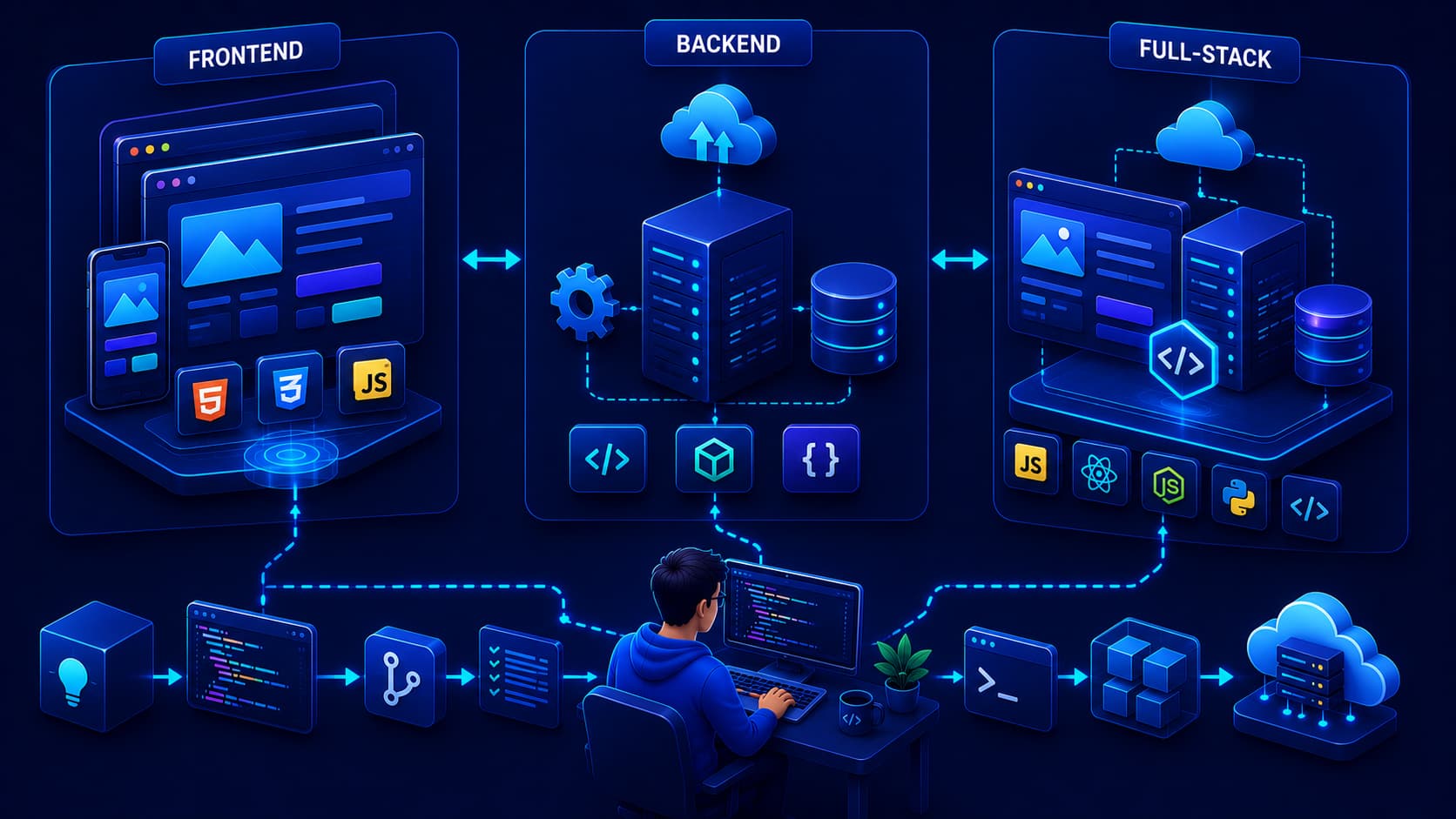
When you open a website, everything seems to happen instantly. You click a button, a page loads, you sign in to your account, photos appear, messages are delivered, and payments are processed within seconds. Behind these simple interactions, however, is a collection of technologies working together. Some components handle everything users can see and interact with, while others manage processing, business logic, databases, and communication behind the scenes.
To make software easier to build and maintain, these responsibilities are typically divided into different areas of development. The three most common roles are frontend development, backend development, and full-stack development. Although each focuses on different aspects of an application, they work together to create complete, functional software. Understanding these roles provides a much clearer picture of how modern web applications are built.
What Is Frontend Development?
Frontend development focuses on the parts of an application that users can see and interact with directly. Everything displayed in a web browser—including layouts, buttons, menus, forms, animations, images, and navigation—is considered part of the frontend.
The primary goal of frontend development is to create interfaces that are:
- Visually appealing.
- Responsive across different devices.
- Easy to navigate.
- Comfortable and intuitive to use.
Whenever you click a button, complete an online form, search for products, or browse an e-commerce website, you're interacting with the frontend. A successful frontend is more than attractive design—it delivers a smooth user experience that feels fast and natural.
Practical Example
Imagine visiting an online shopping website.
Everything you see—including the homepage layout, product cards, navigation menu, search bar, shopping cart icon, and checkout form—is built by frontend developers. Their responsibility is to ensure these elements display correctly on desktops, tablets, and smartphones while remaining easy for users to interact with.
Editorial Insight
Many beginners assume frontend development is only about making websites look attractive. In reality, frontend developers spend significant time improving usability, accessibility, responsiveness, and performance so applications remain enjoyable to use across a wide range of devices and internet connections.
What Is Backend Development?
While the frontend is visible to users, the backend operates entirely behind the scenes. Backend development manages the application's business logic, processes user requests, communicates with databases, and ensures information is stored and retrieved correctly.
For example, when you sign in to an online account:
- The frontend sends your login credentials.
- The backend verifies the information.
- It checks the database.
- It determines whether the login is valid.
- It sends the result back to the frontend.
Although users rarely interact with the backend directly, it powers nearly every feature found in modern websites and applications. Without it, authentication, payments, messaging, shopping carts, and many other essential services simply would not function.
Best Practice
A well-designed backend focuses on much more than functionality. It also prioritizes security, performance, scalability, and data integrity to ensure applications remain reliable as the number of users grows.
How Frontend and Backend Work Together
A helpful analogy is a restaurant.
The dining area is where customers interact with menus, tables, and staff. The kitchen prepares the meals behind the scenes. Customers rarely enter the kitchen, but both areas must work together to create a satisfying dining experience.
Web applications function in much the same way.
- The frontend presents information to users.
- Users interact with the interface.
- The backend receives those requests.
- It performs the necessary processing.
- The backend returns the appropriate results.
- The frontend updates the display accordingly.
Neither side can create a complete application independently. Frontend and backend development depend on one another to deliver a seamless user experience.
What Is Full-Stack Development?
A full-stack developer understands both frontend and backend development. Instead of specializing exclusively in one area, full-stack developers can build complete applications, from the user interface to the server and database.
Being full-stack does not mean knowing every programming language or framework. Rather, it means understanding how different parts of an application fit together and being capable of working across multiple layers of the software stack.
Full-stack developers are particularly valuable in:
- Startups.
- Small development teams.
- Freelance projects.
- Personal software projects.
Because they can contribute across multiple areas, they often help bridge communication between frontend and backend specialists while maintaining a broader understanding of the overall application architecture.
Do Frontend and Backend Use the Same Programming Languages?
Not always. Although both frontend and backend development involve programming, they often rely on different technologies because they solve different types of problems. Frontend development focuses on building user interfaces that run inside a web browser, while backend development is responsible for processing data, implementing business logic, communicating with databases, and handling requests from users.
Because their responsibilities differ, developers usually choose programming languages and tools that are best suited to each environment. However, modern software development has become increasingly flexible. Some programming languages can now be used for both frontend and backend development, making it easier for teams to share knowledge and streamline parts of the development process.
Editorial Insight
Beginners often spend a lot of time wondering which programming language they should learn first. While choosing a language is important, understanding the role each part of an application plays is even more valuable. Once you understand the responsibilities of the frontend and backend, learning new languages becomes much easier.
How Data Flows Through a Web Application
To better understand how frontend and backend development work together, consider a simple login process. Although it usually takes only a second or two, several systems cooperate behind the scenes to complete the request.
A typical login process looks like this:
- You enter your username and password.
- The frontend sends the login request to the backend.
- The backend checks the credentials against the database.
- If the information is correct, the backend creates a secure session or authentication token.
- The backend sends the response back to the frontend.
- The frontend updates the interface and grants access to your account.
Although users only notice the final result, every step is essential. If any part of the process fails—such as the database being unavailable or the backend returning an error—the login cannot be completed successfully.
Practical Example
The same communication pattern occurs throughout modern web applications:
- Submitting an online registration form.
- Purchasing products from an e-commerce website.
- Sending messages in a chat application.
- Updating a user profile.
- Uploading images or documents.
In every case, the frontend collects user input, the backend processes the request, and the frontend presents the results.
Which Path Should Beginners Choose?
One of the first questions aspiring programmers ask is whether they should begin with frontend or backend development. There is no universal answer because the best choice depends on your interests and the types of applications you want to build.
You may enjoy frontend development if you like:
- Designing user interfaces.
- Creating interactive websites.
- Improving user experience.
- Working with layouts, animations, and visual components.
You may prefer backend development if you enjoy:
- Solving logical problems.
- Working with databases.
- Building APIs.
- Designing application architecture.
- Managing servers and business logic.
If you're interested in understanding the entire software development process, full-stack development provides the opportunity to learn both areas over time. Many professional developers eventually gain experience across multiple parts of the software stack, even if they begin by specializing in only one discipline.
Best Practice
You don't need to decide your lifelong career path immediately. Many developers begin by mastering one area, then gradually expand into the other as their confidence and experience grow. Building a strong foundation is usually more valuable than trying to learn everything at once.
Do You Need to Learn Everything?
Beginners sometimes believe they must master frontend development, backend development, databases, cloud infrastructure, DevOps, cybersecurity, and numerous other technologies before they are ready for a professional career. In reality, that expectation is neither practical nor necessary.
Professional software development is highly collaborative. Frontend developers frequently work alongside backend developers, while backend developers collaborate with database engineers, designers, testers, cloud specialists, and security professionals. Each team member contributes expertise in a particular area rather than trying to master every technology.
The most effective learning strategy is to build a strong foundation in one area while gradually expanding your knowledge over time. This approach makes learning more manageable and helps you develop practical skills through real-world experience rather than trying to absorb everything at once.
Common Misconceptions
As with many programming topics, frontend, backend, and full-stack development are often misunderstood by beginners. Clearing up these misconceptions helps you develop more realistic expectations about each role and the skills they require.
Full-Stack Developers Know Every Technology
Not at all.
A full-stack developer understands multiple layers of an application, but no one can realistically master every programming language, framework, database, cloud platform, and development tool. Technology evolves far too quickly for that to be possible. Instead, strong problem-solving skills and the ability to learn new technologies are usually much more valuable than memorizing countless tools.
Editorial Insight
The term full-stack doesn't mean "knows everything." It means understanding how different parts of an application work together. Experienced full-stack developers continue learning throughout their careers because the technology landscape is constantly changing.
Frontend Development Is Only About Design
Although frontend developers work with visual interfaces, their responsibilities extend far beyond appearance. They build interactive experiences, improve accessibility, optimize performance, and ensure applications behave consistently across different browsers, devices, and screen sizes.
A successful frontend is a balance of aesthetics, usability, responsiveness, and technical implementation. Creating an attractive interface is important, but ensuring that users can efficiently accomplish their tasks is equally critical.
Backend Development Is Invisible, So It's Less Important
Quite the opposite.
The backend powers authentication, business rules, databases, payment processing, APIs, notifications, and countless other services that users rely on every day. Without a reliable backend, even the most visually impressive interface would be unable to perform meaningful tasks.
Best Practice
Rather than comparing frontend and backend development, think of them as complementary disciplines. A successful application requires both a polished user experience and a robust backend infrastructure.
Frequently Asked Questions
What's the Difference Between Frontend and Backend?
The frontend consists of everything users see and interact with directly, while the backend handles the processing, business logic, databases, and server-side operations that support those interactions. Both are essential parts of a complete application.
Is Full-Stack Development Harder?
Full-stack development covers a broader range of topics because it combines both frontend and backend knowledge. However, most developers acquire these skills gradually over time rather than trying to learn everything at once.
Can I Become a Full-Stack Developer as a Beginner?
Yes.
Many developers eventually become full-stack developers by first building a strong foundation in either frontend or backend development and then expanding into the other area as their experience grows.
Which Role Has Better Career Opportunities?
Frontend, backend, and full-stack developers are all in strong demand. The best path depends on your interests, strengths, and long-term career goals rather than on one role being universally better than another.
Do Frontend Developers Need to Understand Backend Development?
Frontend developers don't need to become backend experts, but understanding how the frontend communicates with the backend makes collaboration easier and helps developers build better applications.
Conclusion
Modern web applications rely on close collaboration between frontend and backend development. The frontend creates the user experience that people interact with, while the backend provides the logic, data management, and services that make those interactions possible. Full-stack development brings these two worlds together by combining knowledge of both sides into a broader skill set.
Whether you choose to specialize in frontend development, backend development, or eventually become a full-stack developer, understanding how these roles work together provides a solid foundation for building modern software. As your programming journey continues, you'll discover that successful applications are rarely powered by a single technology—they're the result of many specialized components working together seamlessly.
Final Takeaway
Frontend, backend, and full-stack development each play a unique role in creating modern applications.
Keep these key ideas in mind:
- The frontend focuses on what users see and interact with.
- The backend manages business logic, databases, and server-side processing.
- Full-stack developers understand both sides and how they work together.
- You don't need to master every technology before starting your career.
- Build a strong foundation first, then expand your knowledge gradually as you gain experience.
Understanding these development roles will help you choose a learning path that matches your interests while giving you a clearer picture of how modern software is designed, built, and maintained.