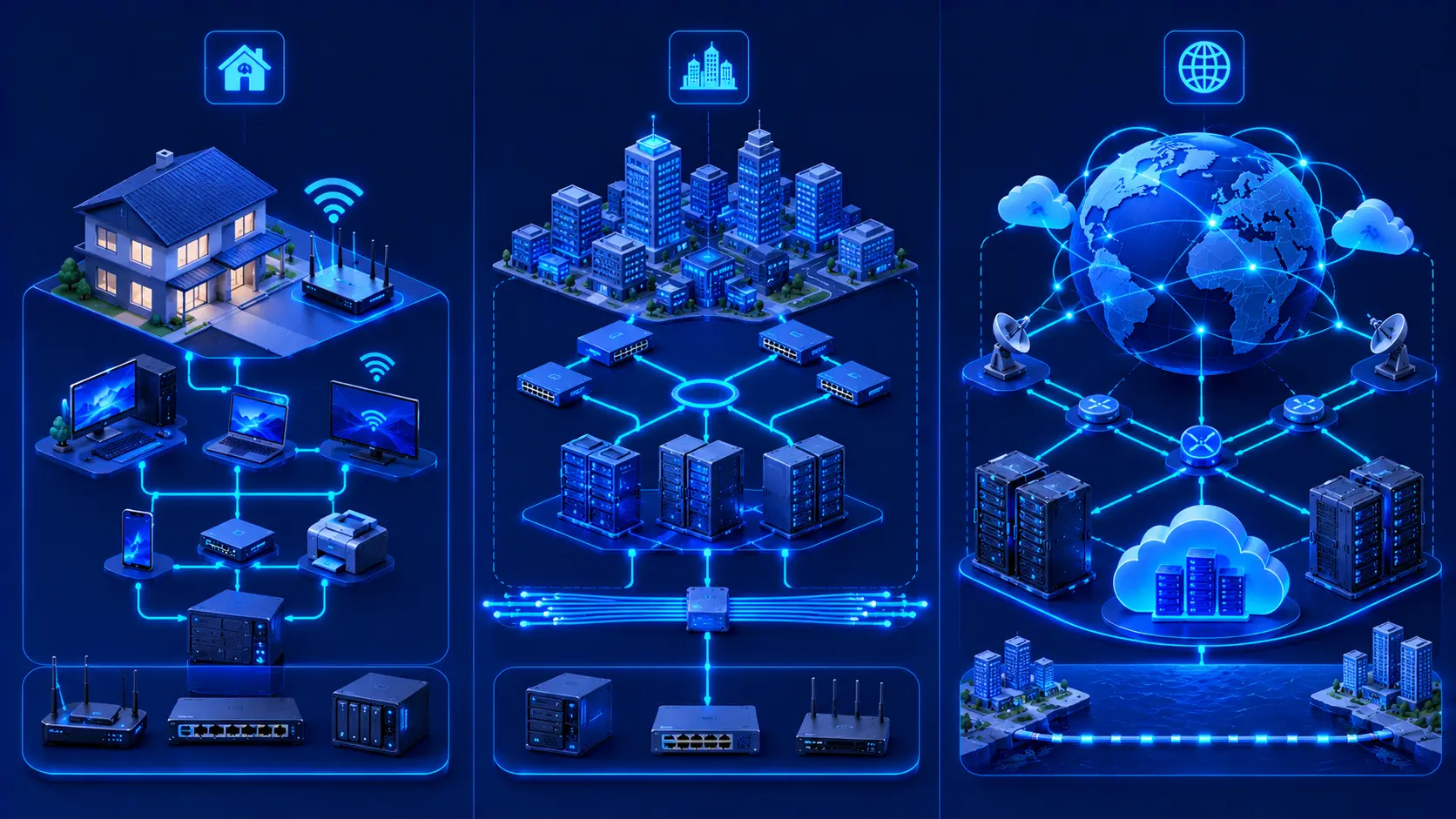
Computer networks come in many different sizes. Some connect devices within a single room, while others span multiple buildings, entire cities, or even continents. Rather than relying on a single type of network for every situation, networking uses different categories based primarily on geographic coverage. Three of the most common network types are Local Area Networks (LANs), Metropolitan Area Networks (MANs), and Wide Area Networks (WANs).
Although these network types differ significantly in scale, they all share the same goal: enabling digital devices to communicate and exchange information efficiently. Understanding the differences between LAN, MAN, and WAN helps explain how everything from your home Wi-Fi network to the global internet is organized.
What Is a LAN?
A Local Area Network (LAN) connects devices within a relatively small geographic area. LANs are commonly found in:
- Homes.
- Offices.
- Schools.
- University campuses.
- Small businesses.
A typical LAN connects devices such as desktop computers, laptops, smartphones, printers, network-attached storage (NAS), and smart home equipment. Because these devices are located close together, LANs usually provide high-speed communication with very low latency, making them ideal for day-to-day computing tasks. Most home Wi-Fi networks are examples of LANs.
Practical Example
Imagine a small office with twenty employees.
Every computer is connected to:
- A shared printer.
- A central file server.
- The office internet connection.
- Internal business applications.
Since all devices are located within the same building, they communicate quickly through a Local Area Network.
Editorial Insight
LANs are designed to maximize speed and efficiency within a limited area. Because data travels relatively short distances, LANs generally deliver faster performance and lower latency than larger network types.
Advantages of LANs
Local Area Networks provide numerous benefits for both homes and businesses. Some of their most important advantages include:
- Fast data transfer.
- Easy file sharing.
- Shared printers and storage.
- Centralized resource management.
- Lower operating costs.
- Simple administration for smaller environments.
Organizations benefit from LANs because employees can efficiently access shared files, applications, and hardware without needing separate resources for every user. This improves collaboration while reducing equipment and maintenance costs.
Best Practice
For offices and schools, a well-designed LAN should prioritize reliability, security, and scalability—not just speed. Proper planning makes future expansion much easier as more users and devices are added.
What Is a MAN?
A Metropolitan Area Network (MAN) connects multiple Local Area Networks across a city or large metropolitan area. Instead of serving a single building, a MAN links several LANs together so they can communicate as one larger network.
Common examples include:
- University campuses spread across multiple locations.
- Municipal government networks.
- City-wide educational networks.
- Large healthcare organizations operating multiple facilities.
MANs provide much greater geographic coverage than LANs while remaining considerably smaller than nationwide or global networks. They allow organizations with multiple locations throughout a city to operate more efficiently by sharing resources and maintaining consistent communication.
Practical Example
Consider a university with several campuses located throughout a city.
Each campus operates its own Local Area Network, but all campuses are connected through a Metropolitan Area Network. This allows students and staff to access the same learning systems, digital libraries, and administrative services regardless of which campus they visit.
Advantages of MANs
Compared with isolated Local Area Networks, Metropolitan Area Networks provide broader connectivity while maintaining efficient communication across a city or metropolitan region. Organizations that operate from multiple locations often rely on MANs to integrate their facilities into a unified network.
Key advantages include:
- Communication between multiple sites.
- Shared city-wide services.
- Improved collaboration across organizations.
- Efficient resource sharing over larger geographic areas.
By linking separate Local Area Networks, MANs allow organizations to centralize applications, share data more effectively, and improve operational efficiency without requiring each location to function independently.
Editorial Insight
A Metropolitan Area Network is particularly valuable for organizations whose facilities are spread across the same city. Rather than maintaining isolated systems at each location, a MAN enables employees to work as though they are connected to a single, larger network.
What Is a WAN?
A Wide Area Network (WAN) connects networks across large geographic regions. Unlike LANs and MANs, WANs may span countries, continents, or even the entire world. The most well-known example of a WAN is the internet, which links millions of smaller networks together.
Businesses also build private WANs to connect offices located in different cities or countries. This enables employees to access shared applications, databases, and company resources regardless of their physical location.
Practical Example
Imagine a multinational company with offices in:
- New York.
- London.
- Singapore.
- Tokyo.
Although these offices are thousands of miles apart, employees can securely access the same business systems and collaborate through a Wide Area Network.
Advantages of WANs
Wide Area Networks make large-scale communication possible by connecting geographically distant locations. They provide the infrastructure needed for modern global businesses and cloud-based services.
Major benefits include:
- Connecting offices in different cities or countries.
- Supporting remote work.
- Providing access to centralized applications.
- Enabling cloud computing services.
- Allowing global communication and collaboration.
Without WANs, organizations with offices in multiple regions would struggle to share information efficiently and maintain consistent operations across all locations.
Best Practice
As a network grows geographically, planning becomes increasingly important. Reliable WAN performance depends on well-designed infrastructure, secure communication, and effective network management rather than simply expanding coverage.
Comparing LAN, MAN, and WAN
Although LANs, MANs, and WANs all exist to connect devices and facilitate communication, they differ significantly in terms of coverage, typical users, performance, and complexity.
| Feature | LAN | MAN | WAN |
|---|---|---|---|
| Coverage | Single room, building, or campus | City or metropolitan area | Country, continent, or worldwide |
| Typical Users | Homes, schools, offices | Universities, municipalities, large organizations | Enterprises, internet providers, global organizations |
| Speed | Usually very high | High | Varies depending on infrastructure |
| Complexity | Low | Moderate | High |
| Example | Home Wi-Fi | City government network | The Internet |
Rather than competing with one another, each network type is designed to solve different communication challenges. The right choice depends on the geographic scope and operational requirements of the environment.
How LAN, MAN, and WAN Work Together
In practice, these network types are rarely isolated. Instead, they often work together to create larger communication systems. For example:
- Your laptop connects to a LAN through your home Wi-Fi.
- Your internet service provider connects that LAN to a much larger WAN.
- A university may connect several campus LANs through a MAN.
- Those interconnected networks can then access the global internet, which is itself a WAN.
This layered networking approach enables billions of devices around the world to communicate seamlessly despite being separated by enormous distances.
Practical Example
When you browse a website from home, your request may travel through your home's Local Area Network, continue across your internet provider's Wide Area Network, and eventually reach a server located in another country. Although multiple network types are involved, the entire process typically takes only a fraction of a second.
Real-World Examples
Understanding network types becomes much easier when you see how they are used in everyday situations. The following examples demonstrate how LANs, MANs, and WANs are applied in real-world environments.
Home Network (LAN)
A family uses Wi-Fi to connect laptops, smartphones, smart TVs, gaming consoles, and printers within a single house. Because all of these devices communicate within a relatively small area, this setup is considered a Local Area Network (LAN).
The LAN allows family members to:
- Share an internet connection.
- Print documents from multiple devices.
- Stream media to smart TVs.
- Access files stored on network-attached storage (NAS).
This is the most common type of network encountered by everyday users.
City Government (MAN)
Several municipal offices throughout a city share databases, internal applications, and communication systems through a city-wide fiber network. Because multiple Local Area Networks are connected across the same metropolitan area, this is an example of a Metropolitan Area Network (MAN).
A MAN allows city departments to collaborate efficiently while maintaining centralized access to public services and administrative systems.
International Company (WAN)
A multinational company operates offices in New York, London, Singapore, and Tokyo. Employees at every location access the same business applications and communicate through a Wide Area Network (WAN), allowing the organization to function as a unified enterprise despite being distributed across multiple countries.
Editorial Insight
These examples highlight an important point: network type is determined primarily by geographic scope, not by the devices being connected. A laptop can participate in a LAN, MAN, or WAN depending on the overall network architecture.
Common Misconceptions
The Internet Is Not the Only WAN
Although the internet is the largest and most widely recognized Wide Area Network, it is not the only one. Many organizations build private WANs that connect only their own offices, data centers, and business services. These private networks provide secure communication without exposing internal systems directly to the public internet.
Bigger Doesn't Always Mean Better
A WAN covers a much larger geographic area than a LAN, but that does not automatically make it the best solution. Each network type is designed for specific requirements. Using a WAN where a LAN would be sufficient introduces unnecessary complexity and additional costs without providing meaningful benefits.
Wi-Fi Doesn't Define the Network Type
Many people assume that using Wi-Fi automatically means they are using a LAN. While Wi-Fi is commonly associated with Local Area Networks, wireless technologies can also be part of MANs and WANs. The type of network is determined by its geographic coverage and overall architecture—not simply by whether devices connect wirelessly.
Best Practice
When identifying a network, ask yourself how large an area it covers, rather than focusing on whether it uses Wi-Fi or cables. Geographic scope is the defining characteristic that distinguishes LANs, MANs, and WANs.
Frequently Asked Questions
What Is the Main Difference Between LAN, MAN, and WAN?
The primary difference is geographic coverage. LANs serve small local areas, MANs connect locations across cities, and WANs connect networks across countries or even the entire world.
Is the Internet a WAN?
Yes.
The internet is the world's largest and most widely used Wide Area Network, connecting millions of smaller networks across the globe.
Can a Company Use All Three Network Types?
Yes.
A large organization may operate LANs within individual offices, connect offices throughout a city using a MAN, and link offices in different countries through a WAN. These network types complement one another rather than compete.
Which Network Type Is Fastest?
LANs generally provide the highest speeds and lowest latency because devices are located close together. However, actual performance also depends on network hardware, design, and available infrastructure.
Do Home Users Need a MAN?
Typically, no.
Most homes only require a Local Area Network connected to the internet through a Wide Area Network provided by an internet service provider.
Conclusion
LANs, MANs, and WANs each play an essential role in modern networking. LANs provide fast communication within homes, schools, and offices. MANs connect multiple local networks across metropolitan areas, while WANs enable communication across countries and continents, making global connectivity possible.
Rather than competing with one another, these network types work together to create the interconnected digital world we rely on every day. Understanding how they differ provides a solid foundation for learning more advanced networking concepts, including IP addressing, routing, switching, and network security.
Final Takeaway
When studying computer networking, remember these key principles:
- LANs connect devices within a small local area, such as a home or office.
- MANs connect multiple Local Area Networks across a city or metropolitan region.
- WANs connect networks over large geographic distances, including countries and continents.
- The internet is the largest example of a WAN.
- Different network types are designed for different communication needs and often work together within a larger infrastructure.
- Geographic coverage—not whether the connection is wired or wireless—is what defines the type of network.
By understanding the roles of LANs, MANs, and WANs, you'll have a strong foundation for exploring more advanced networking topics and better appreciate how modern digital communication systems operate.