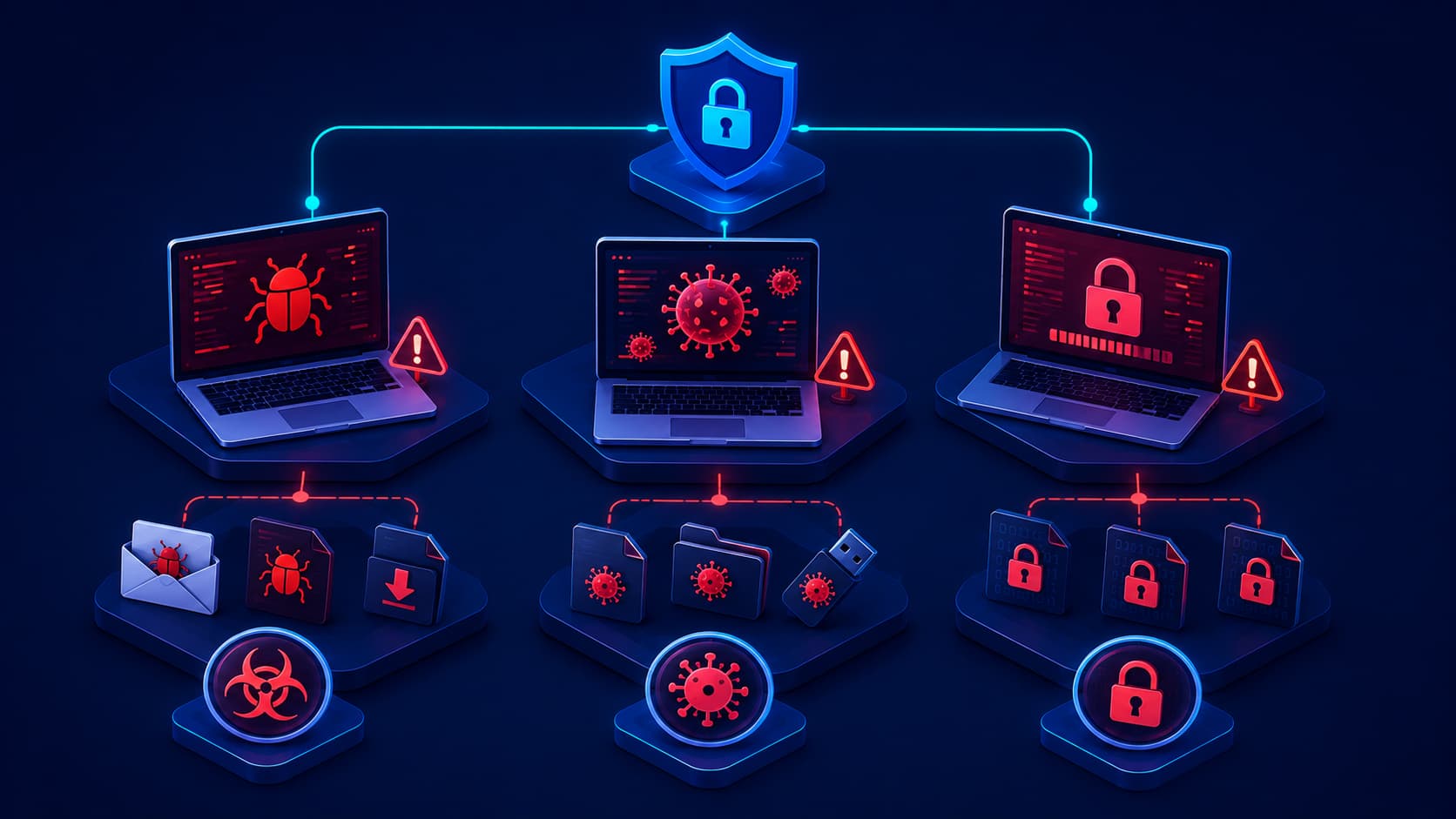
News headlines often use terms like virus, malware, and ransomware as if they all describe the same thing.
It's an understandable mistake because all three are associated with cyberattacks and can cause serious damage to computers, smartphones, and business systems. However, these terms are not interchangeable.
In fact, using the wrong terminology can make cybersecurity much more confusing, especially for beginners.
The easiest way to understand the relationship is to think of malware as the broad category.
A virus is one specific type of malware.
A ransomware program is another.
In other words:
- Every virus is malware.
- Every ransomware program is malware.
- Not every piece of malware is a virus or ransomware.
Understanding this relationship makes it much easier to recognize different cyber threats and understand how they behave.
What Is Malware?
Malware is short for malicious software.
It is a general term used to describe any software intentionally created to:
- Damage devices.
- Steal information.
- Spy on users.
- Gain unauthorized access to computer systems.
Rather than referring to a single program, malware includes many categories of malicious software.
Some malware is designed to destroy files.
Others silently collect passwords.
Some display unwanted advertisements, while others allow attackers to remotely control infected devices.
Because malware serves many different purposes, cybersecurity professionals classify it into several categories based on how it behaves.
Why Malware Is Considered an Umbrella Term
Think of malware as a large family of malicious software.
Within that family are many different "members," each with its own behavior and objective.
For example:
- A virus focuses on spreading between files.
- Ransomware encrypts data for financial extortion.
- Spyware secretly collects information.
- Trojans disguise themselves as legitimate software.
Although their methods differ, they all belong to the broader malware category.
Editorial Insight
One of the most common misconceptions among beginners is using the word virus to describe every computer infection. In professional cybersecurity, using the correct terminology helps communicate threats more accurately and understand the appropriate defensive strategies.
What Is a Virus?
A virus is one of the oldest and most recognizable types of malware.
Its defining characteristic is that it attaches itself to legitimate files or programs and spreads when those files are opened or shared.
Much like a biological virus spreads from one person to another, a computer virus spreads by infecting additional files and systems.
Depending on its design, a virus may:
- Display unwanted messages.
- Corrupt files.
- Damage operating systems.
- Reduce overall computer performance.
Although viruses remain an important cybersecurity concern, they are no longer the most common form of malware encountered today.
How Computer Viruses Spread
Unlike some modern malware that spreads automatically, traditional viruses usually require some form of user interaction.
Examples include:
- Opening an infected file.
- Running an infected application.
- Sharing infected removable media.
- Downloading compromised software.
Because they rely on users to execute infected files, awareness and cautious computing habits remain effective preventive measures.
Best Practice
Avoid downloading software from unknown websites, scan downloaded files before opening them, and keep your operating system updated to reduce the likelihood of virus infections.
What Is Ransomware?
Ransomware is a specialized type of malware designed to deny users access to their own data.
Rather than quietly stealing information, ransomware encrypts files so they can no longer be opened.
Victims are then presented with a demand for payment in exchange for a decryption key.
These attacks affect not only individuals but also:
- Businesses.
- Hospitals.
- Schools.
- Government organizations.
In many cases, normal operations may be disrupted for days or even weeks while systems are restored from backups.
Because of its significant financial and operational impact, ransomware has become one of the most serious cybersecurity threats facing organizations today.
Why Ransomware Is So Dangerous
Unlike many other malware types, ransomware immediately disrupts access to important information.
Organizations may lose access to customer databases, financial records, operational systems, or critical business applications.
Even if backups exist, recovery often requires significant time, planning, and resources.
Why People Often Confuse These Terms
Part of the confusion comes from everyday language.
For many years, people referred to almost every computer infection simply as a virus.
As cybersecurity evolved, however, experts recognized that malicious software comes in many forms, each using different techniques and requiring different defensive strategies.
Using the correct terminology helps people better understand:
- How attacks spread.
- What damage they can cause.
- Which security measures are most effective against them.
Other Types of Malware
Viruses and ransomware often receive the most public attention, but they represent only two members of a much larger malware family.
Understanding the other common malware categories provides a more complete picture of today's cybersecurity landscape.
Each type has its own method of infecting systems, spreading to new devices, and achieving its objective.
Worms
Unlike a traditional virus, a worm does not need to attach itself to another file or program.
Instead, worms spread automatically by exploiting vulnerabilities in networks or software.
Because they can replicate without requiring user interaction, worms often spread much faster than traditional viruses.
In large organizations, a single infected computer may be enough for a worm to move rapidly across an entire network if proper security controls are not in place.
Why Worms Spread So Quickly
A virus generally depends on users opening infected files.
A worm, however, actively searches for vulnerable systems on its own.
This ability to self-replicate makes worms particularly dangerous in environments with outdated software or poorly secured networks.
Trojans
A Trojan, or Trojan horse, disguises itself as legitimate software.
It may appear to be:
- A useful application.
- A software update.
- A harmless document.
- A free utility program.
Once installed, however, it performs malicious actions behind the scenes.
Depending on its purpose, a Trojan may:
- Steal passwords.
- Install additional malware.
- Allow attackers to remotely control an infected device.
Unlike viruses, Trojans do not reproduce themselves.
Their success depends on convincing users to install them voluntarily.
Spyware
As its name suggests, spyware is designed to secretly monitor user activity.
Without the user's knowledge, spyware may collect:
- Browsing history.
- Login credentials.
- Financial information.
- Other personal data.
Because spyware usually operates silently in the background, victims often remain unaware until suspicious activity appears in their accounts or sensitive information has already been stolen.
Adware
Adware is generally considered less dangerous than ransomware or spyware, but it can still create security and privacy concerns.
Its primary purpose is to display unwanted advertisements, often generating revenue for its creators.
Some forms of adware also:
- Track browsing behavior.
- Redirect users to suspicious websites.
- Reduce overall system performance.
Although not all adware is intentionally malicious, aggressive or unauthorized advertising software can negatively affect both user privacy and the overall computing experience.
Editorial Insight
Modern malware rarely exists in isolation. A Trojan might install ransomware, spyware may steal passwords that enable credential attacks, and malware families frequently work together as part of larger cyberattack campaigns. Understanding these relationships makes it easier to recognize how complex today's cyber threats have become.
Side-by-Side Comparison
One of the easiest ways to understand these threats is to compare their primary objectives. The original comparison table highlights the different goals and typical impacts of each malware category.
| Threat | Primary Goal | Typical Impact |
|---|---|---|
| Malware | General category for malicious software | Covers many different cyber threats |
| Virus | Infect and spread through files | Damaged files and reduced system performance |
| Ransomware | Encrypt files and demand payment | Loss of access to important data |
| Worm | Self-replicate across networks | Rapid spread between systems |
| Trojan | Disguise itself as legitimate software | Unauthorized access or malware installation |
| Spyware | Secretly collect information | Theft of personal or financial data |
| Adware | Display unwanted advertisements | Privacy concerns and reduced system performance |
Although each threat behaves differently, they are all forms of malware designed to compromise systems in one way or another.
How Can You Protect Yourself?
The good news is that many malware infections can be prevented by following a few basic security practices.
Some of the most effective habits include:
- Keep your operating system and applications updated.
- Download software only from trusted sources.
- Avoid opening unexpected email attachments.
- Never click suspicious links.
- Use reputable security software with real-time protection enabled.
- Regularly back up important files.
- Stay informed about evolving cyber threats.
No single security tool can stop every type of malware.
Instead, combining multiple defensive practices creates stronger protection against a wide range of cyber threats.
Best Practice
Treat unexpected downloads, software updates, and email attachments with caution—even if they appear legitimate. Verifying the source before opening a file is one of the simplest ways to avoid many malware infections.
Frequently Asked Questions
Is Every Virus Considered Malware?
Yes.
A virus is one category of malware.
While every virus is malware, not every type of malware is a virus.
Think of malware as the broad category, with viruses representing just one specific type within that category.
Is Ransomware a Virus?
No.
Ransomware is a type of malware specifically designed to encrypt files and demand payment for their recovery. Although both viruses and ransomware are malicious software, they behave very differently.
A virus focuses on spreading between files or systems, while ransomware focuses on denying access to data in order to extort money from victims.
Which Type of Malware Is the Most Dangerous?
There isn't a single answer.
Ransomware can cause severe financial and operational damage, while spyware may silently steal sensitive information over a long period. The level of risk depends on the attack's objective and the environment being targeted.
For example:
- A ransomware attack may temporarily shut down an entire organization.
- Spyware may quietly collect banking credentials for months without being detected.
- A worm may spread rapidly across a corporate network.
- A Trojan may create a hidden backdoor for future attacks.
Each malware category presents different risks and requires different defensive strategies.
Can Antivirus Software Detect Ransomware?
Modern security software can detect many ransomware variants, but no solution guarantees complete protection.
Effective protection also depends on:
- Regular software updates.
- Frequent data backups.
- Safe browsing habits.
- User awareness.
- Strong overall cybersecurity practices.
Security works best when multiple layers of protection are used together.
Why Do People Still Call Every Malware a Virus?
The term virus became widely recognized long before many modern malware categories existed.
As a result, people often use it as a general label for any malicious software, even though cybersecurity professionals distinguish clearly between different malware types.
Using the correct terminology improves communication and makes cybersecurity concepts easier to understand.
Editorial Insight
Understanding the differences between malware categories isn't just about learning technical vocabulary. It also helps you recognize how different attacks operate, what warning signs to watch for, and which security measures are most effective against each threat.
Conclusion
Although the terms malware, virus, and ransomware are often used interchangeably, they describe different concepts.
Malware is the broad category that includes many forms of malicious software, while viruses and ransomware are specific types with their own behaviors and objectives.
Understanding these distinctions isn't simply about using the correct terminology.
It also helps you understand:
- How different attacks spread.
- What kind of damage they can cause.
- Which security measures are most appropriate for preventing them.
As cyber threats continue to evolve, having a clear understanding of these fundamentals makes it much easier to stay informed and make better cybersecurity decisions.
Final Takeaway
Every virus is malware, but malware includes far more than just viruses.
Today's threat landscape also includes ransomware, worms, Trojans, spyware, adware, and many other specialized forms of malicious software, each designed to achieve different objectives.
By understanding how these threats differ—and by practicing safe browsing habits, keeping software updated, using reputable security tools, and maintaining regular backups—you'll be better prepared to protect your devices and personal information from the constantly evolving world of cyber threats.