Every time you open a web browser, edit a document, play a game, or watch a video, your computer needs quick access to large amounts of information. Retrieving that information directly from long-term storage every time would be far too slow. Instead, computers rely on a much faster type of memory known as Random Access Memory (RAM).
RAM temporarily stores the data and instructions that the processor is actively using. By keeping important information readily available, it allows applications to respond quickly and helps the computer switch efficiently between multiple tasks.
Although RAM works closely with the CPU, it serves a very different purpose. The CPU performs calculations and executes instructions, while RAM provides the temporary workspace that allows those instructions to be processed efficiently. Understanding how RAM works is essential for learning why computers perform differently under various workloads and why memory capacity can significantly affect the overall user experience.
What Is RAM?
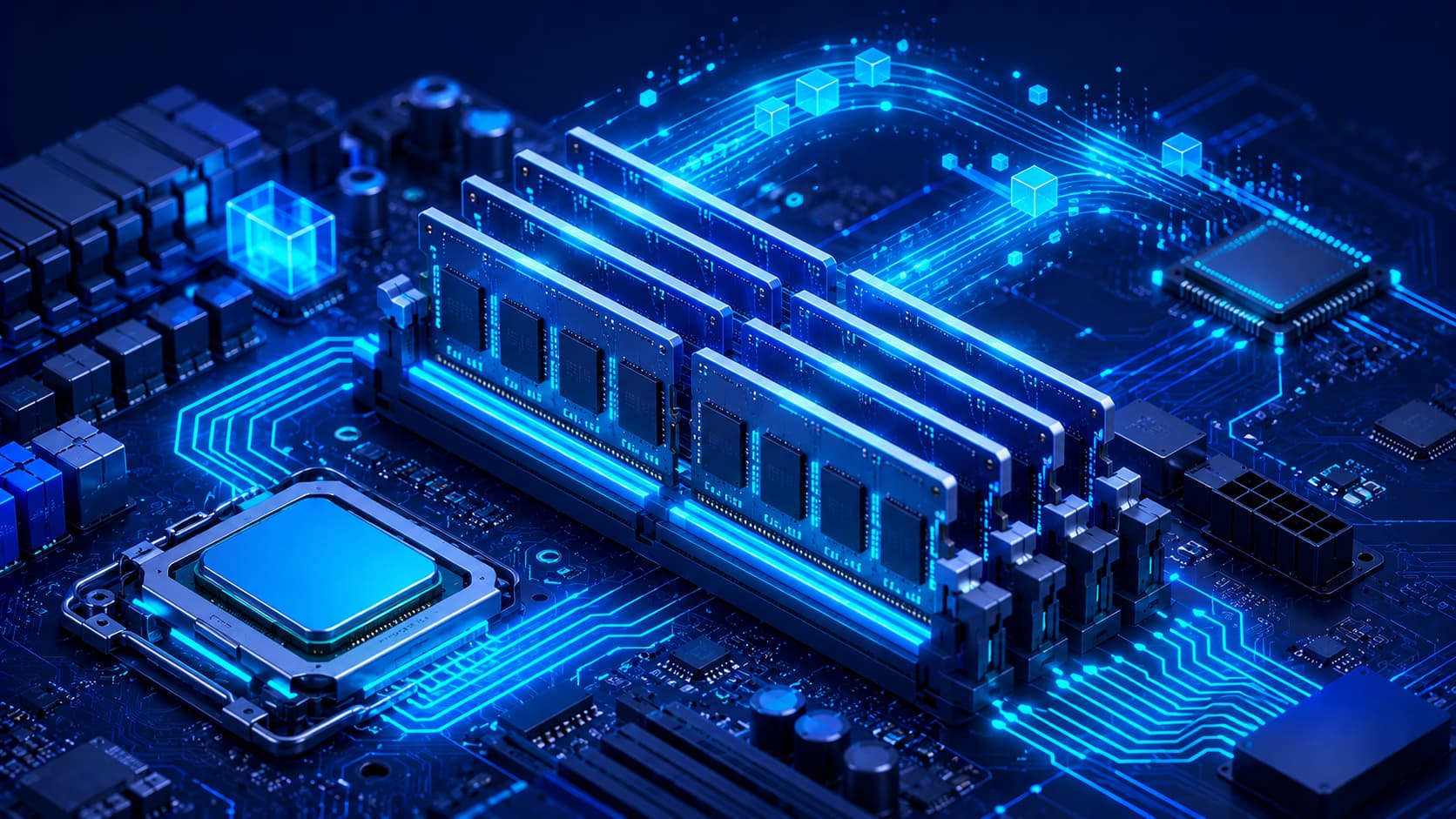
Random Access Memory (RAM) is a type of high-speed computer memory that temporarily stores the information currently needed by the processor.
Unlike long-term storage, RAM is designed for rapid access rather than permanent data retention.
Whenever applications are running, the operating system loads the necessary data into RAM so the CPU can retrieve it quickly. Because RAM operates much faster than traditional storage devices, it significantly reduces delays and improves application responsiveness.
However, RAM is volatile memory, meaning its contents are generally erased when the computer is powered off. Unlike files stored on an SSD or HDD, information in RAM is not intended for permanent storage.
Practical Example
Imagine you're editing a presentation.
While you're working:
- The presentation file is loaded into RAM.
- Every edit you make is temporarily stored there.
- The CPU accesses that data continuously while you work.
When you click Save, the updated document is written to permanent storage. If the computer loses power before you save your work, the unsaved changes stored only in RAM are typically lost.
Why Is RAM Important?
RAM allows computers to work efficiently with active data. Without sufficient memory, the processor would need to retrieve information from storage much more frequently, resulting in slower performance.
Additional RAM often improves multitasking because more applications and active data can remain readily available at the same time.
This enables users to:
- Switch between applications more smoothly.
- Reduce loading delays.
- Improve responsiveness during demanding workloads.
Although RAM alone cannot make every computer dramatically faster, it plays a critical role in overall system performance.
Editorial Insight
Many users notice the biggest benefit of additional RAM when running several applications simultaneously. Instead of constantly moving data between memory and storage, the computer can keep more information immediately available, resulting in a smoother and more responsive experience.
How RAM Works
When you launch an application, the operating system loads the necessary program files and active data into RAM. The CPU then retrieves instructions and information from memory whenever they are needed.
As you continue working, RAM constantly updates its contents to reflect the applications and files currently in use.
When an application is closed, much of the memory it occupied becomes available for other programs.
This continuous cycle allows computers to efficiently manage multiple applications while maintaining responsive performance.
How the Process Works
A simplified sequence looks like this:
- You open an application.
- The operating system loads its data into RAM.
- The CPU reads and processes that information.
- RAM continuously updates as the application runs.
- When the application closes, the memory becomes available for new tasks.
This process happens continuously throughout the time your computer is running.
RAM and the CPU
RAM and the CPU work together continuously to keep your computer running efficiently. While the CPU executes instructions, RAM supplies those instructions and the associated data quickly enough to keep the processor busy.
If RAM were significantly slower, the processor would spend more time waiting for information instead of performing useful work. As a result, memory performance has a direct impact on how responsive a computer feels during everyday use.
Although these two components have different responsibilities, they are highly dependent on one another. A powerful processor cannot perform at its best if it constantly waits for data to arrive from memory.
Practical Example
Imagine you're editing a large photo.
- The image is loaded into RAM.
- The CPU continuously retrieves image data from memory.
- Every adjustment you make is processed immediately.
- RAM stores the updated information while you continue editing.
Without fast memory, each action would take noticeably longer because the processor would spend more time waiting for data instead of processing it.
RAM vs Storage
One of the most common misconceptions is that RAM and storage perform the same function. In reality, they serve very different purposes.
The primary difference is:
- RAM is designed for temporary, high-speed access.
- Storage is designed for long-term data retention.
For example:
- When you save a document, it is written to storage.
- When you open that document, the operating system loads it into RAM so the CPU can work with it efficiently.
Once the computer is turned off, the contents of RAM are generally erased, while the document remains safely stored on the storage device.
RAM vs Storage at a Glance
| RAM | Storage |
|---|---|
| Temporary memory | Permanent storage |
| Very fast | Slower than RAM |
| Stores active data | Stores files and applications |
| Cleared when power is off | Data remains after shutdown |
Understanding this distinction helps explain why installing more RAM is very different from increasing storage capacity.
Editorial Insight
Many users purchase a larger SSD expecting better multitasking. While faster storage can reduce loading times, it doesn't replace the role of RAM. Memory and storage solve different performance challenges and should be viewed as complementary components rather than interchangeable upgrades.
How RAM Affects Performance
RAM has a significant influence on how smoothly a computer performs everyday tasks.
When sufficient memory is available, applications can remain active without constantly transferring data between RAM and storage.
This improves responsiveness, especially when:
- Running multiple applications simultaneously.
- Working with large documents.
- Editing photos or videos.
- Developing software.
- Using virtual machines.
- Keeping dozens of browser tabs open.
If available memory becomes limited, the operating system may rely more heavily on storage as temporary working space.
Because storage is generally much slower than RAM, this can noticeably reduce overall system responsiveness.
Best Practice
If your computer frequently slows down while multitasking, monitor how much memory is being used before upgrading other hardware.
For workloads that regularly consume most of the available RAM, increasing memory capacity can provide a smoother experience by allowing more applications and active data to remain readily accessible.
Modern Computers Use RAM Efficiently
Today's operating systems are designed to manage memory automatically. Rather than leaving RAM empty, they intelligently use available memory to cache frequently accessed data and improve application loading times.
As different programs are opened and closed, memory is continuously allocated and released based on current demand.
This dynamic memory management allows modern computers to make efficient use of available RAM while supporting many simultaneous tasks without requiring manual intervention.
Editorial Insight
Many users worry when they see high memory usage in system monitoring tools. In many cases, this is perfectly normal. Modern operating systems intentionally use unused RAM to cache frequently accessed data because available memory provides no performance benefit when left empty. If an application needs additional memory, the operating system automatically reallocates it as required.
Types of RAM
Computer memory has evolved considerably over the years. Modern systems use different generations of RAM that provide improvements in speed, efficiency, and capacity.
Although memory technology continues to evolve, the fundamental purpose remains unchanged: providing the processor with fast access to active data.
For most users, understanding what RAM does is more important than memorizing the technical differences between memory generations.
Can You Upgrade RAM?
Many desktop computers allow users to increase memory capacity by installing additional RAM modules. Some laptops also support memory upgrades, although others have memory permanently integrated into the system.
Whether a device can be upgraded depends on its hardware design.
Before purchasing new memory, you should verify:
- Your computer's motherboard compatibility.
- The supported memory type.
- The maximum RAM capacity.
- The number of available memory slots.
Installing incompatible memory may prevent the computer from booting or limit its performance.
Best Practice
Before upgrading RAM, consult your computer manufacturer's documentation or motherboard specifications. Confirming compatibility beforehand helps avoid purchasing memory that your system cannot use.
Common Misconceptions About RAM
Understanding what RAM does—and what it doesn't do—helps avoid several common misconceptions.
More RAM Doesn't Automatically Make Every Computer Faster
Installing additional RAM can improve performance when memory is the limiting factor. However, if your computer already has enough RAM for its workload, adding significantly more memory may produce little noticeable improvement.
Overall system performance also depends on:
- The processor (CPU).
- Storage performance.
- Graphics hardware.
- Software optimization.
A balanced system usually delivers better real-world results than focusing on a single hardware upgrade.
RAM Is Not Permanent Storage
Many beginners confuse RAM with storage devices.
RAM temporarily stores active information while the computer is running.
Long-term files—including your operating system, applications, photos, and documents—remain stored on dedicated storage devices even after the computer is powered off.
Clearing RAM Isn't Usually Necessary
Some users believe they must manually "clear RAM" on a regular basis. Modern operating systems automatically manage memory allocation and recovery, making manual intervention unnecessary in most situations.
Restarting a computer can free memory used by running applications, but under normal conditions the operating system is already designed to manage RAM efficiently.
Editorial Insight
It's common to see advice online suggesting that users should constantly optimize or manually clear RAM. For most modern computers, this isn't necessary. Current operating systems are designed to allocate and release memory dynamically, allowing applications to use available RAM efficiently without requiring manual management.
Frequently Asked Questions
What Is RAM in Simple Terms?
RAM is temporary high-speed memory that stores the information your computer is actively using so the processor can access it quickly.
Why Is RAM Important?
RAM improves application responsiveness and allows computers to run multiple tasks efficiently by providing fast access to active data.
Does More RAM Always Improve Performance?
Not always.
Additional RAM helps when memory is limited, but other hardware components also influence overall system performance, including the CPU, storage, and graphics hardware.
What's the Difference Between RAM and Storage?
RAM temporarily stores active data while the computer is running.
Storage permanently keeps the operating system, applications, and personal files even after the computer is turned off.
Does RAM Lose Data When the Computer Is Powered Off?
Yes.
Standard RAM is volatile memory, meaning its contents are generally cleared when power is removed from the computer.
Conclusion
Random Access Memory (RAM) is one of the most important components in modern computing. By providing fast temporary storage for active applications and data, RAM enables the processor to work efficiently while supporting multitasking and responsive software performance.
Although RAM is often discussed alongside processors and storage devices, its role is unique. It serves as the computer's temporary workspace, allowing information to be accessed much more quickly than long-term storage alone. Understanding how RAM works helps explain why memory capacity has such a significant impact on everyday computing performance.
Final Takeaway
RAM is far more than just another hardware specification—it's the high-speed workspace that keeps your computer responsive while you work, browse, create, and multitask. Understanding how RAM interacts with the CPU, why it differs from storage, and how memory capacity affects performance will help you make more informed decisions when purchasing, upgrading, or troubleshooting a computer.
As modern software continues to become more demanding, having sufficient RAM remains one of the most effective ways to ensure a smooth and enjoyable computing experience.